All Around the World with the Most Travelled Indian
 By NITIN GAIROLA
A desert in its literal definition should be a place devoid of rain, vegetation and life. This applies more to the other planets in the solar system (classic desert being Mars) but definitely not to Earth as our deserts are teeming with life – of various forms. But ours is a planet so full of life everywhere that in comparison to rest of the places, the deserts hold relatively less of it. Our deserts are scientifically defined as areas that receive less than 25 cm or 10 inches of precipitation in a year and this desert biome covers 1/3rd of our planet today.
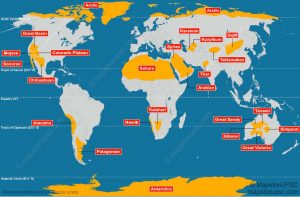
However, it is not a constant biome, which is the case with all biomes on Earth. Basically forests, grasslands and deserts are not fixed in terms of their boundaries – They have shifting borders. So forests transition to woodlands which turn to grasslands, then scrublands and finally we have the deserts. This change of natural cover or vegetation is primarily caused by precipitation and temperature or what is known as the climate. The climate in turn depends on both the latitude and the altitude, besides other geographic factors such as nearness to water bodies, mountains etc.
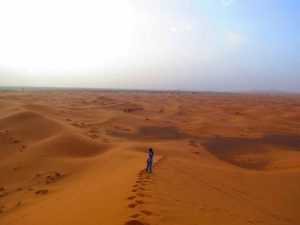
And just as forests are being lost to farms to feed the growing human population, we are also losing our grasslands to deserts as they expand their boundaries due to more frequent droughts in a warming planet. That is what is known as the desertification of Earth and it is a very ‘hot’ topic today (pun intended).
As I had mentioned in an earlier article on forests, the governments of many countries where deserts are the dominant biome, are already working on greening their browns and it’s a battle going on against the deserts. There is a classic Ted Talk by Allan Savory called ‘How to green the world’s deserts and reverse climate change’. I would really recommend you taking out 20 minutes of your life for this classic piece by Allan. I assure you it will be well worth your time.
Just to add that these anti-desertification initiatives are not always directly benefiting our forest growth, since there is economics involved here too. Deserts are wastelands and barring tourism, they do not draw any revenue for the governments. However if these become more green and fertile like grasslands, they could be used for agriculture i.e. to create food related revenue and self-sustenance. Of course, it doesn’t hurt to call it a ‘save the planet’ initiative so as to get funding for the ideas too.
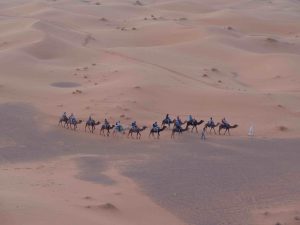
So right now I am not too sure how the biomes of this planet would look in future, since these biomes were very static till the 1950s but post that things have been very dynamic. While the individual deserts are still the same, but they have expanded. And while the major individual forests are also the same, but they have either diminished or have been degraded substantially and hence have become fragmented. However this is hardly due to desertification, instead they have been lost to farm lands. So the future biomes on our planet will change dramatically because of only one factor, which is us. That is the scale of impact we are having on the natural cover of the planet that many scientists have proposed giving this recent geological epoch it’s very own name – The Anthropocene. So we are unofficially out of the Holocene that started 11,700 years ago post the end of the last Ice Age and into the ‘Age of Man’.
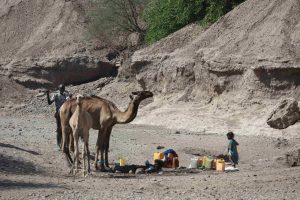
The worry is this – If the Earth loses a certain critical mass of forests and a certain critical mass of ice caps, then we may get into an irreversible feedback loop of a warming planet with greater concentration of carbon dioxide or CO2. Both of these conditions are not good for the climate, for biodiversity on Earth and definitely not good for us. And deserts are not all evil either, since the Sahara Desert’s dust is the reason why we have the Amazon Rainforest in Brazil. You see the dust from North Africa is carried by Trade Winds and the Saharan Air Layer (SAL) on a rotating planet and they cross the Atlantic Ocean and reach the Amazon in South America. Over millions of years, these dust particles, which are full of phosphorous and iron, have become the fertilizers for the plants & trees in the Amazon Basin.

But as beautiful and other-worldly as deserts are, there is a reason why such places are referred to as alien landscapes. Deserts are alien since they are nearly the only type of landscape found on other planets in the Solar System. As we know that no other planet has complex life as we have on Earth (not even bacterial life has been found) and this complex life on Earth is there because we have forests, grasslands and oceans. The alien landscapes of deserts are not conducive for our blue-green bowl and that is the reason why it is crucial to come in the path of expanding deserts and halt their progress.

Africans are building ‘The Great Green Wall’ of trees across the Sahara to stop it from eating into the middle of their continent, an area called the Sahel region. This Sahel holds some of the highest density of a fast growing population anywhere on Earth and the last thing you would want in such a place is a lack of water and resources. I truly believe we must make such kind of walls (and not the ones being proposed by someone who blows his ‘trumpet’) to stop the real enemy. I say this despite deserts being my first love in the natural world (as a traveller) for their stark beauty and their remoteness. I also love deserts as much as I do since I am just 3 deserts shy of visiting all of them around the world and becoming the first Indian to do so. But regardless of my love for deserts, I have to remember that the Great Wall of China was built to keep the invaders out in antiquity. The Great Green Wall is also being built to keep an invader at bay – one that could threaten the very stability of our planet.
(Nitin Gairola is from Dehradun and has travelled the natural world more than almost any Indian ever. He has set world travel records certified by India Book of Records, has written for Lonely Planet, and holds National Geographic conservation certifications. He is also a senior corporate executive in an MNC and in his early days, used to be a published poet as well. More than anything else, he loves his Himalayan home. Reach him at: www.facebook.com/ MostTravelledIndian/)