Garhwal Post Bureau
Srinagar (Garhwal), 8 Sep: The second day of the two-day national seminar on “Uttarakhand’s Folk Culture and Pop Culture in the Digital Age”, organised by the Department of Hindi and Modern Indian Languages, Birla Campus, Hemwati Nandan Bahuguna Garhwal University, under the aegis of the Indian Council of Social Science Research (ICSSR), witnessed extensive deliberations on the preservation, promotion, innovation and global dissemination of folk culture.
The third academic session and the valedictory session of the seminar featured captivating performances by folk artists along with research paper presentations by scholars from various universities.
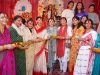
The third academic session began at 10 a.m. and was chaired by Prof DS Negi, Director, MMTC, while Dr Anoop Semwal conducted the session. During the session, young Uttarakhand folk artists Arvind Chauhan and Anurag Nautiyal were felicitated with mementoes and certificates of appreciation for their contribution to the promotion and dissemination of Uttarakhand’s folk culture.
Folk artist Arvind Chauhan, through his musical performances, emphasised that a harmonious blend of ancient and contemporary musical traditions is essential for preserving folk culture. Presenting the famous Garhwali folk ballad Jeetu Bagdwal in a lyrical form, he highlighted the integration of traditional mountain instruments with modern and Western instruments as an important characteristic of folk music in the digital age.
Young folk singer Anurag Nautiyal began his presentation with a traditional Mangal Geet. He described digital platforms as an important medium providing new opportunities to folk artists and talented youth. He observed that the digital era has enabled economically weaker and emerging artists to showcase their talent on a wider platform. He also emphasised the significant role of mountain folk songs in keeping the Uttarakhand diaspora connected with its folk culture and traditions.
The Chief Guest at the session, Dr Ajay Kumar Singh, underlined the seriousness and sensitivity of the seminar’s theme and described innovation as a key element of culture. He said that folk culture should not be confined within rigid traditions; rather, it must retain its dynamism, continuity and capacity for change. He cautioned that evaluating culture solely through the lens of the past could become an obstacle to its wider expansion.
He said that the digital age has provided a significant opportunity to establish Uttarakhand’s folk culture not only at the national but also at the global level. For this, planned and sustained efforts are required. He also stressed the need for transmitting folk culture from one generation to another. At the conclusion of his address, he presented a song dedicated to Uttarakhand’s folk culture, creating an emotional atmosphere in the auditorium.
This was followed by presentations of 15 research papers by scholars from various universities on diverse themes.
In his presidential address, Prof DS Negi expressed gratitude to all the speakers and participants and appreciated the organising committee for the successful conduct of the seminar. Referring to the work being undertaken internationally in the field of folk culture and the opportunities available in this area, he emphasised the need for sustained efforts to maintain the relevance of such academic initiatives.
Following the lunch break, the valedictory session of the seminar was held under the chairmanship of Prof OP Gusain, Dean, Student Welfare. Prof YP Revani, Registrar, was the Chief Guest, while Prof Rajendra Singh Negi, Deputy Director, Chauras Campus, attended as the Guest of Honour.
During the valedictory session, renowned Uttarakhand folk singer Anjali Khare and folk singer Sachin Pusaula presented various aspects of Uttarakhand’s folk culture and its relationship with the digital age through their songs and artistic performances. Their performances enthralled the audience and provided a vivid experience of the richness and vitality of Uttarakhand’s folk traditions.
Another 15 research papers were presented during the session. Certificates were also distributed to teachers and research scholars from various universities who had presented papers in different sessions of the seminar.
Chief Guest Prof YP Revani said that folk culture represents the collective memory of a society and forms the foundation of its identity. Digital platforms have created new opportunities to take folk culture to a wider audience, he said.
He added that seminars of this nature at the university inspire students and research scholars to understand their folk traditions and contribute towards their preservation. He also emphasised the need for systematic documentation and digital archiving of Uttarakhand’s folk culture.
In his presidential address, Prof OP Gusain said that folk culture is not merely a legacy of the past but a living expression of contemporary life. He emphasised that technology in the digital age should be used not to replace folk traditions but to take them to younger generations.
He said that connecting students and youth with their roots, language, folk songs, folk narratives and traditions is the need of the hour.
Prof Rajendra Singh Negi said that Uttarakhand possesses an exceptionally rich and diverse folk culture. Digital technology has multiplied the possibilities for its preservation, documentation and dissemination, he said.
He emphasised that the need of the hour is to present folk arts on digital platforms along with their original context and authenticity, so that future generations can remain familiar with and connected to their rich cultural heritage.
The session was conducted by Dr Anoop Semwal. At the conclusion of the seminar, Prof Manjula Rana, Head, Department of Hindi, expressed her gratitude to all the guests, speakers, research scholars and participants.
Thereafter, Dr Kapil Dev Panwar, Coordinator of the Seminar, thanked all the guests, speakers, research scholars, members of the organising committee, university officials, teachers, employees and students for their support and active participation.
Dr Kapil Dev Panwar formally announced the conclusion of the two-day national seminar.