
 By Atul Rawat
The very foundation of Dev Bhoomi, nestled in the lap of the mighty Himalayas, rests upon its forest cover. Along with the snow-capped peaks, these forests are the soul of Uttarakhand. The towering pines, majestic sal trees, and stately deodars have stood guard over these mountains for centuries, protecting and nurturing the land and its people.
Walking along forest trails, one cannot help but marvel at their grandeur. The fragrance of the earth, mixed with the scent of pine needles, is both refreshing and deeply calming. These forests are more than a collection of trees; they are living ecosystems that define the identity of the state.
Yet, year after year, they continue to burn.
Every year, forest fires arrive with frightening predictability. Slowly but surely, a part of us burns along with these forests. Climate change is often cited as the principal cause, and rightly so, but many of these fires are also the result of human negligence and deliberate acts. Their contribution to this crisis is equally significant, if not greater.
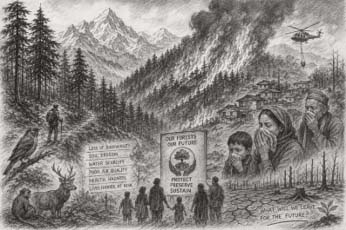
Every year, we witness dense forests wrapped in smoke and orange flames crawling across mountain slopes through the night. For a state celebrated for its pristine mountains, sacred rivers, rich biodiversity, and spiritual serenity, forest fires are no longer isolated incidents. They have evolved into a full-blown ecological crisis.
The increasing pressure of infrastructure development, expanding road networks, and the arrival of several lakh tourists and their vehicles each year place an ever-growing burden on these fragile ecosystems. While development and tourism are essential for economic growth, they must coexist with responsible environmental stewardship.
The question is no longer whether there will be a tipping point, but when. Will it arrive in the next 10 years, 20 years, or by 2047? No one can say with certainty, but if the current trend continues, its arrival is only a matter of time.
Can we imagine these lush green mountains transformed into blackened landscapes? It is no longer unusual to travel through valleys filled with smoke for kilometres at a stretch. One wonders about the villagers who live amid these conditions, breathing smoke-filled polluted air for days on end. The smoke severely affects air quality, leading to respiratory illnesses, particularly among children and the elderly.
And what about the wildlife?
What happens to the birds whose nests are destroyed before their fledglings can fly, or to the small mammals, reptiles, insects, and countless microorganisms that perish silently? How long can the flora and fauna survive this relentless cycle of destruction?
The consequences of forest fires extend far beyond the flames. Entire ecosystems collapse. Medicinal plants disappear, fertile topsoil loses its nutrients and becomes vulnerable to erosion during the monsoon, and the forests gradually lose their ability to retain water. Springs and streams that sustain mountain communities begin to dry up, threatening both biodiversity and human survival.
For thousands of villages in the State, these forests are an indispensable source of fodder, firewood, water security, and livelihood. When they burn, rural communities lose much more than trees; they lose a way of life.
There is an urgent need to ensure that environmental consciousness keeps pace with rising human activity. Nature must be celebrated not merely for its beauty but also through responsible action and sustainable living.
The inevitable question arises: who should act?
Should it be the State Government, the Central Government, the Panchayats, or ordinary citizens? Or should the courts step in?
The answer lies somewhere in the middle. Every stakeholder has a role to play. Protecting the forests is not merely a governmental obligation but a solemn shared duty. There is no denying, however, that there is an urgent, mission-oriented need to address this issue.
The alternative is too frightening to be left to the mercy of the monsoon. When the flora and fauna are gone, what use will state-of-the-art infrastructure be?
It often appears as though nature is expected to heal itself from the damage inflicted by humans. Such a one-sided arrangement cannot last forever. What if one day nature decides that it can no longer fulfil its part of the bargain? The Himalayas are not infinite in their capacity to absorb the pain of human neglect. It is the proverbial death by a thousand cuts.
Forest fires cannot be tackled through seasonal panic alone. Every year, we witness temporary outrage, emergency meetings, and reactive firefighting efforts. Once the rains arrive, public attention fades until the next summer brings another round of devastation.
This cycle must end.
Perhaps the greatest challenge before us is not the fire itself but our collective indifference. The present generation continues to exploit natural resources, leaving future generations to bear the cost.
Environmental protection must move beyond speeches, slogans, and annual campaigns. It must become a collective civic responsibility and an everyday habit.
The forests of Uttarakhand are not merely trees standing on mountain slopes. They are the state’s natural heritage, its climate regulators, its water reservoirs, its biodiversity, and its spiritual soul.
If we fail to protect them today, future generations may inherit the Himalayas not as a living sanctuary of green cover but as a silent landscape of ash, smoke, and memory.
The choice, and the responsibility, are ours.


