All Around the World with the Most Travelled Indian
 By NITIN GAIROLA
From Samarkand in the east of Uzbekistan we were to take the overnight train to the far, far west of the country to Khiva (or Xiva as it is locally written). The Uzbek train was rather similar to our own and had the open sleeper class and also private compartments or coupes, with lockable doors. There were coupes for 4 people and for only 2 as well. We had selected the coupe for 4 but in hindsight we would have gone with either the fully private one (more expensive) or the open compartment (the cheapest). This is because of a scary and bizarre incident that night in the train, but thankfully it wasn’t a case of ‘Murder on the Orient Express’.

In the train we had two very strange strangers in our coupe (we had hoped to luck out with an empty compartment). One of the men was sounding extra friendly and told me how he loved Bollywood movies. But what got me really concerned was that an hour later the other man, who was more silent, actually took out an injection, filled it up and kept it on his upper berth. We got really worried thinking that this duo may drug us and take away all our stuff in the night. So, we asked this shady person what the injection was for. He simply replied ‘I am a doctor’, and since English wasn’t his language, we really couldn’t carry on the conversation any further. With that non-conclusive response our sleep was gone and so we decided to take turns. Initially, both of us were up but in between we did catch some shut eye. However, even when dozing off for a few minutes, I was always on my guard. Our concern had been further compounded by the fact that the entire compartment had only men and no families were to be seen, even though there were quite a few on the platform. Just the luck of the draw I suppose.

Seven hours passed this way until the morning came, and we were able to open the compartment doors and heaved a sigh of relief. A few stops later those two characters got down and we felt it was a miracle that we were left unharmed. We finally got some much-needed sleep, perhaps for a few hours, before the train arrived in Khiva.
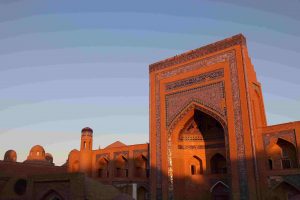
But Khiva or Xiva was not what we had made it out to be in our imaginations (as a rule we don’t see YouTube travel videos and only read articles about a place so as to not fully reveal a place and kill the element of surprise). We thought we would get another Marrakesh or another Fez or Petra and the like but, instead, what we got was an ancient town full of tourist shops in every corner and western tourists inside them. We also met one wonderful Indian traveller named Pooja Patil from Pune.
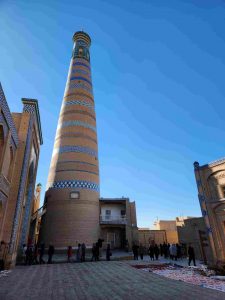
Now let me be clear that Khiva was beautiful, but it was so beautiful that it was almost too good to be true. What I mean by that is that Kiva is a 2,500 year old town but the buildings of this so called ancient place were in near mint condition. So, what happened in this case of reverse-aging gone wrong? We noticed that across Uzbekistan there is a drive to ‘beautify’ their ruins; basically to do a bit of a ‘paint job’ on history. Many historical centres even have newly constructed homes and hotels inside them but they have been ‘absorbed’ as part of the site just by syncing up the colours and the designs. All this somehow lends the sites an extremely curated look. You really can’t distinguish the old from the new, it is all done for the tourists and not the purists.

We were left wondering what if Khiva had been left alone and what if it did not carry the weight of so many tourists shopping in souvenir shops. Just how majestic and eye-popping it could have actually been. And I am not saying that there shouldn’t be people in such historical places. Well, actually far from it as people add so much colour and charm to the old markets as you have in Fez and Marrakesh in Morocco. I was simply saddened by the fact that here the tourists were easily distinguishable from the locals – since all the locals were shop owners and none were shoppers or travellers. Clearly there was no local who was in Khiva to buy everyday wares or reminisce about the old times while sipping tea in a café. They were there to trade with tourists, who in turn were there just to take Instagrammable photographs and not to share stories with strangers.
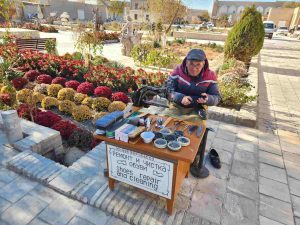
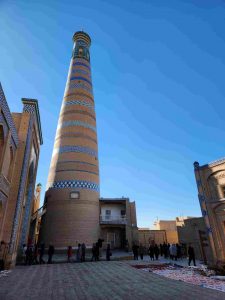
I look back at our three days in Khiva and they were indeed delightful. I wouldn’t change anything even if I could go back in time and I strongly recommend people visit this great city but just be aware that it is perfectly polished for YouTube videos and Instagram photos and is now just a vestige of the past. Here is an ancient town with perfectly clean pathways, with perfectly clean minarets studded with little mirrors and with hotels that seamlessly blend into the old architecture. You really can’t make out where the hotel ends and the heritage starts, or if the hotel is indeed considered history & heritage. But to be kind to Khiva, the best part about it was actually the amazing detours you can do from the city.
All the deserts of Uzbekistan can easily be accessed from here – the Kara-Kum in the south, the Kyzyl-Kum in the north and the Ustyurt Plateau in the far west. I will cover these in the upcoming features on this Central Asia overland adventure of ours.

So, even if Khiva is not as mysterious as say a town in Syria, Jordan, Morocco or Algeria, you will still end up capturing some amazing glimpses and images of old Islamic architecture and that too in all the safety and comfort you could ask for. You see, tourism is a big revenue generator for Uzbekistan and the government ensures that the Uzbek police keep the tourists out of harm’s way, as much as possible. For those who enjoy their creature comforts we also found a wonderful restaurant to eat, but it is again not what we imagined to find in an Islamic country. The joint was serving yummy continental food complemented with terrace and balcony views and accompanied with western music and polite waiters. The only thing exotic, I suppose, were the ‘magic carpets’ placed all over their walls to give it an ‘authentic’ feel. The restaurant itself had an out-of-place name – Terrassa Café, since it had (you guessed it) a terrace. In all honesty, the views from the terrace and balconies were to die for, especially after a few vodka shots in minus two degree temperatures at night (it was sub-zero without any snow since Khiva is in the middle of a cold dry desert).

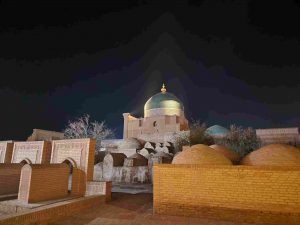
The real beauty of Khiva shines out when you decide to stay overnight inside the walled city (called Itchan Kala). It is a bit pricy with the various hotel taxes, but the magic starts when the hawkers and the hoards leave, and you suddenly have this pale illuminated past to yourself. So, Khiva is a complex emotion and mixed bag really and a lot depends on what you seek as a traveller. I can’t say I disliked it because that would be a lie, but my imagination did run wild before the trip. It is far from the greatest mediaeval city you will ever see, and it is indeed a pity that in Uzbekistan there is a wave of such restoration of historical sites. In my view (and that of some locals), they have taken it one step too far with flood lights on the monuments. In Khiva, the illumination was still done with a dignified pale yellow light, but in Samarkand we saw the reds, the greens and the blues which made the past appear very garish. Instagrammable it certainly is, but Khiva is not your ticket to a lost time. Here the traveller in you meets the tourist, and they actually embrace each other. It’s true that the vodka helps.
(Nitin Gairola is from Dehradun and has travelled the natural world more than almost any Indian ever. He has set world travel records certified by India Book of Records, has written for Lonely Planet, and holds National Geographic conservation certifications. He is also a senior corporate executive in an MNC and in his early days, used to be a published poet as well. More than anything else, he loves his Himalayan home.