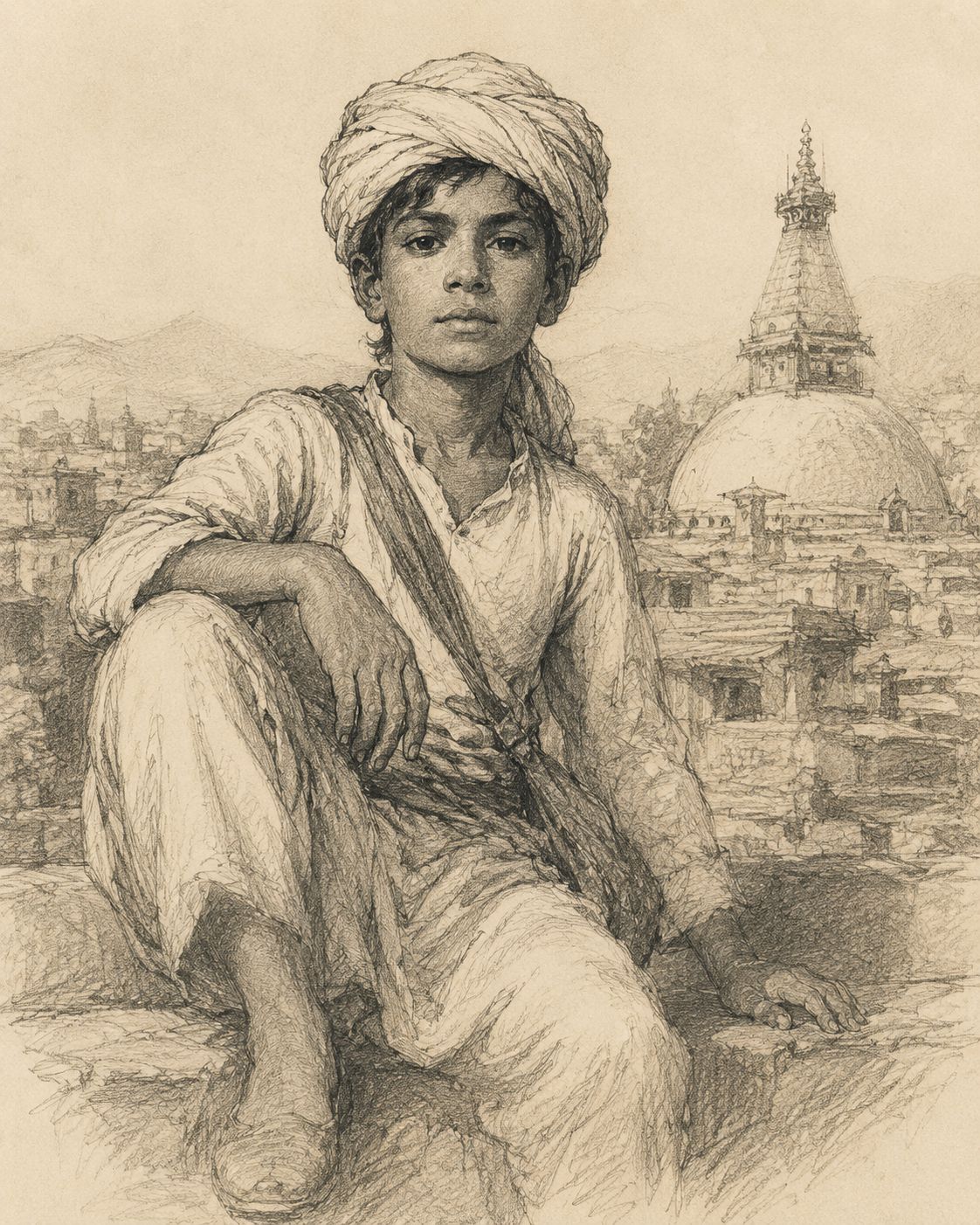
(This is an attempt to revisit Kipling’s “Great Game” against the backdrop of contemporary geopolitical rivalries and ask whether the modern world, too, is filled with individuals negotiating multiple identities, loyalties, and truths. Moving beyond espionage and empire, the piece explores the enduring relevance of Kim as a metaphor for the restless modern self.)
 By Rajshekhar Pant
More than a century ago, the readers were introduced to a young Irish orphan wandering across the dusty roads of colonial India carrying messages, secrets, disguises, and divided loyalties. In Kipling’s imagination, Kimball O’Hara—street-smart, rootless, curious, and culturally fluid—became the perfect operative for the “Great Game”, the nineteenth-century geopolitical rivalry between the British and Russian empires across Central Asia.
The original Great Game was fought not only through armies and diplomacy, but through maps, rumours, coded reports, caravan routes, and men who disappeared into landscapes and identities. Explorers, spies, traders, monks, and adventurers moved through the Himalayas and Central Asia as silent instruments of imperial ambition. Kipling transformed this shadowy contest into literature. Yet Kim was more than an espionage tale. It was also a meditation on identity, belonging, and power.
Today, as a new Great Game unfolds across Asia, one is tempted to ask: where is Kim now?
The geography has changed, but the anxieties remain surprisingly familiar. The mountains of Afghanistan, the passes of the Himalayas, the trade arteries of the Indian Ocean, and the strategic corridors linking South Asia with Central Asia once again occupy global attention. This time the contest involves rising China, an anxious West, a resurgent Russia, regional powers, digital surveillance systems, artificial intelligence, cyber warfare, rare earth minerals, and contested trade routes. Ports, satellites, semiconductor chains, and data networks have become the new caravan trails.
But unlike the nineteenth century, today’s contest is not always visible. It often travels invisibly through algorithms, financial systems, media narratives, and information ecosystems. The spy with coded papers has partly yielded space to the analyst behind a screen. Yet the essential struggle—for influence, access, and strategic advantage—remains unchanged.
In such a world, Kim returns not necessarily as a single character, but as a metaphor.
The modern Kim may be a multilingual researcher navigating conflicting narratives across borders. He may be a journalist in a conflict zone, a cyber analyst decoding digital intrusions, or even a migrant youth carrying fragments of multiple identities. Like Kipling’s Kim, he belongs fully nowhere and therefore moves easily everywhere. He understands several worlds without entirely surrendering himself to any one of them.
Yet Kim survives not merely because of espionage or adventure. He endures because somewhere within most of us lives a small fragment of Kim himself—a restless observer moving between worlds, carrying multiple loyalties, searching for belonging while negotiating the demands of power, society, and conscience. We too move through competing narratives and shifting identities, trying to reconcile the outer compulsions of the world with an inner search for meaning. Perhaps that is why the figure of Kim still feels contemporary. The modern Great Game is not only unfolding between nations; in quieter ways, it unfolds within individuals as well.
This is perhaps why the novel still feels unexpectedly contemporary.
Kim’s greatest skill was not espionage alone. It was cultural adaptability. He could move between bazaars and cantonments, among monks, horse traders, peasants, sahibs, and spies. He listened more than he spoke. He absorbed accents, customs, and silences. In an age increasingly fractured by ideological certainties, this ability to inhabit multiple perspectives without immediate hostility seems almost revolutionary.
At another level, however, the comparison becomes unsettling.
The original Great Game was ultimately an imperial enterprise in which India, itself, was less a participant than a strategic space to be controlled. Even Kim, despite his affection for India, remained tied to the machinery of empire. That ambiguity continues to provoke debate about Kipling. Was he merely celebrating imperial intelligence networks, or was he unconsciously revealing the loneliness and moral confusion embedded within them?
The contemporary Great Game carries similar ambiguities. Nations speak of connectivity, development, security, and partnerships, yet strategic calculations often lurk beneath humanitarian vocabulary. Infrastructure projects become instruments of influence. Technology platforms become tools of surveillance. Narratives themselves become battlegrounds.
In this atmosphere, the figure of Kim acquires fresh symbolic value—not simply as a spy, but as a reminder of the human being trapped between competing powers.
One recalls that throughout the novel; Kim is also travelling with the aged Tibetan lama in search of spiritual liberation. The lama seeks the River of the Arrow, a path beyond illusion and worldly entanglement. This parallel spiritual journey softens the hard edges of espionage and imperial rivalry. Amid intrigue and politics runs another quieter question: can a human being preserve inner freedom while moving through structures of power?
That question has become even more urgent today.
The contemporary individual lives amid constant information warfare, manipulated outrage, algorithmic persuasion, and political polarisation. Every camp demands loyalty. Every ideology seeks recruits. Yet genuine understanding often requires the very quality Kim possessed—the ability to cross boundaries, to listen, to remain intellectually mobile.
Perhaps that is why Kim survives as more than an imperial adventure story. He endures because he represents the uneasy modern condition itself: hybrid, searching, adaptive, and perpetually negotiating between worlds.
For India especially, the metaphor carries special resonance. India once stood at the heart of the old Great Game as the prized possession of empire. Today it stands at the crossroads of another geopolitical contest, this time as an independent actor balancing complex relationships with major powers while safeguarding its own strategic autonomy. The terrain may have shifted from mountain passes to digital corridors, but the stakes remain immense.
And somewhere in the midst of these transitions walks the shadow of Kim—restless, observant, impossible to categorise.
Kipling could scarcely have imagined drones, satellites, cyber espionage, or artificial intelligence. Yet he instinctively understood something enduring about power politics: empires compete not only through force, but through information, perception, and the people capable of moving between worlds.
The modern Great Game therefore does not merely ask who controls territory. It asks who understands civilisations, who interprets cultures, and who can navigate ambiguity without losing moral balance.
That may finally be Kim’s deepest relevance to our times.
Not as a servant of empire, but as a reminder that in ages of rivalry and suspicion, the rarest intelligence is not strategic cunning alone—it is the capacity to remain human while passing through divided worlds.
(The author is an amateur filmmaker, a photographer, and a writer, who has written over a thousand write-ups, reports, etc., published in the leading newspapers and magazines of the country. He can be reached at pant.rajshekhar@gmail.com)