By Ganesh Saili
‘Everyone’s a trifle touched up here – except for you and me!’ says Anil Prakash, adding, ‘At times, even you look weird!’
‘There!’ Mr Agarwal exclaimed, who looked like a spudding potato with flaring nostrils and a nose that twitched whenever he lied. ‘That’s my house!’ he beamed, brimming with confidence.
Of course, it was not his house – the last English owner, a certain Mr Michael Hartley of Lakhimpur Kheri, scuttled ship when independence came and went back home. He simply abandoned the old summer homestead.
‘It looks like a case of intestate,’ said the lawyers.
Sixty years and two suicides later, no local would venture near the place (that’s except the odd lovers seeking a furtive tryst.)
‘They can handle the paperwork!’ said Mr Agarwal, pointing at the lawyers. His nostrils flared again.
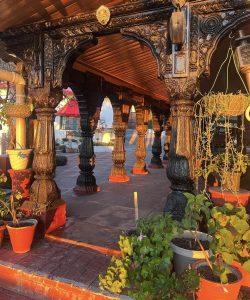
Pic courtesy: Author ‘s collection.
‘Remember, a house must have three things: Location! Location! Location!’ He liked the ring of it, having read Sir Conrad Hilton’s quote. The prospect was pleasing: the vista of the snow-capped peaks stretched from Nanda Devi in the east to the Himachal peaks to the west.
The con job was tailor-made.
Of course, it is easier when folks are drawn like moths to a flame. Years had passed with daydreams of a cottage in Landour-Mussoorie with a bit of lawn. And our old homes wrapped in clumps of trees – deodar, oak and rhododendron – were built by the early pioneers with whatever was at hand. The beams came from the trees, gravel from the nearby quarries, and lime and mortar from the nearby kilns.
Silver quickly changed hands!
Once they moved into the house, they realised they, too had been touched.

As I write, stories from elsewhere come my way. A bushy-tailed accountant (from their old school) wanted them to invest their savings in property.
‘We relied on the ‘old boy’ network.
‘In the middle of summer, we arrived at an expanse of land – flat as a cricket field – except for a clump of trees on a mound in the middle.
‘Earnest money given, the deal was signed. On a lark, we returned to the place in the middle of the monsoon. The land had vanished – instead, a lake as there with a tiny mound no larger than this dining table!’
Elsewhere, another schoolmate, a realtor, had them climbing up a steep hillock.
‘On these slopes, you could develop a terraced rose garden,’ he suggested helpfully as he adjusted his tie.
Walking around, they noticed bits of red cloth mixed with shards of lead.
‘What are these?; they asked.
‘Oh, those are from the army firing range. Don’t worry, they always hoist a red flag before their firing practice starts.’
‘We left!’ they told me.
To me, 1983 is the tipping point for our hills after the turmoil in the Punjab; we became a parking lot for black money whereby everyone had a Plan B.
Nearby lived the pretty Elfie Milling, who, in the 1970s, had acquired a ruin. It did need love, attention and a bit of tweaking. She had to remove the WC that the last owner had thoughtfully planted in the veranda.
Or so she thought!
‘We’re high on the ridge. It’ll attract lightning,’ she said. And so she talked to our expert – a know-it-all who knew-it-all.
Work began on a six-foot-deep earthing pit. Then she stumbled upon a worker painting a cast-iron manhole cover with copper paint!
‘What’s this for?’ she demanded.
Stomping on a cigarette butt, he replied: ‘Madam! It’s cheaper! And when lightning strikes, it won’t know the difference between cast iron or copper!’
Around the corner lived little Jack Horner, getting his wiring replaced. Legend has it that the electrician put some of his switches upside down. Result? On was Off! And Off was On!
‘What difference does it make?’ asked the electrician, puzzled.
Anyway, the switches were set right, the bill was settled, and the owner went to take a shower. When he switched on the geyser, the gate lights came on! He ran to the gate and pressed the doorbell – and Lo! the geyser hummed!
After all, wasn’t it you who had asked for a cottage in these hills?
Ganesh Saili, born and home-grown in the hills, belongs to those select few whose words are illustrated by their pictures. Author of two dozen books, some translated into twenty languages, his work has found recognition worldwide