By SUNIL SONKER
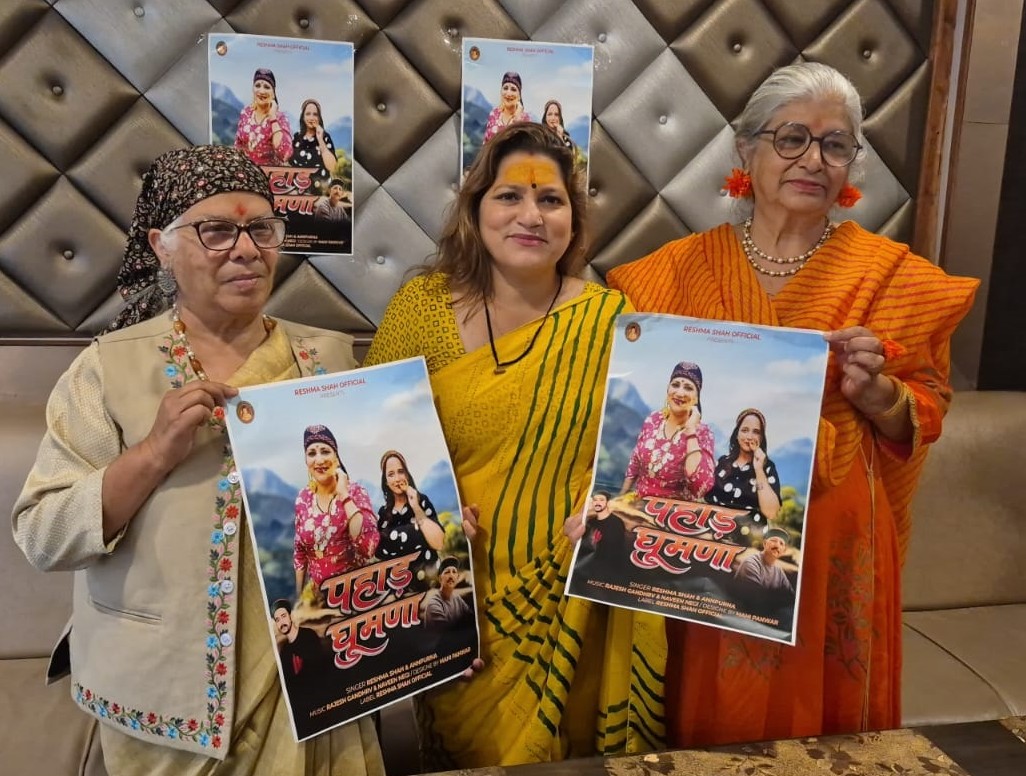
Mussoorie, 3 Aug: Folk singer Dr Reshma Shah has described her new Uttarakhandi song, “Pahad Ghumna”, not merely as a tourism song but as a social message against migration. On the occasion of the song’s launch, here, Madhu Melhotra and Preeti Melhotra honoured Dr Shah by presenting her with a shawl.
Speaking at the event, Dr Shah stated that her objective is not just to showcase Uttarakhand’s natural beauty to the nation and the world, but to reconnect people with their villages, culture, and native soil. Dr Shah mentioned that the song was first launched in Mumbai at the residence of renowned Ghazal and Bhajan singer Anup Jalota on his birthday, an event attended by several prominent Bollywood personalities. She shared that after listening to the song, Anup Jalota praised her voice and even sang a devotional song with her—a gesture she considers a great honour and a source of inspiration.
Reshma Shah remarked that “Pahad Ghumna” is more than just a song; it is a message deeply connected to the soul of Uttarakhand. Through this song, she has endeavoured to present the mountains’ natural beauty, pristine environment, traditional villages, farmlands, orchards, and local culture to the nation, encouraging people to view Uttarakhand not merely as a tourist destination but as a part of their own heritage. She expressed concern over the large-scale migration of people from villages to cities in recent times. This trend is leaving villages deserted, with people selling off their ancestral lands. Rapid concrete construction on these lands is altering the natural landscape of the mountains and increasing the risk of disasters.
Dr Reshma Shah stated, “If villages become deserted, our culture, our dialect, and our identity will also gradually vanish. Everyone should maintain a connection with their village. Visit the village from time to time and look after your homes, fields, orchards, and forests; this is our true wealth.” She noted that while the state government is making continuous efforts to curb migration, government schemes alone are not enough; people must also change their mindset and fulfill their responsibilities toward their birthplace. She remarked that, if after listening to this song, even a few people resolve to return to their villages, preserve their ancestral property, and promote the culture of the hills, then her endeavour would be truly successful.
Vijay Vindwal was also present on the occasion.