 By Ganesh Saili
When I look back over the years, our old banks have always had what might be called a chequered history. Our first bank, The North-West Bank, was floated in 1836 and crashed in 1842. Seventeen years later, the Delhi and London Bank opened in 1859. It was established as the Mansuri Savings Bank in 1864.
Mr F. Moss ( yes, the same Mr. Moss who gave the Jharipani waterfalls their name) launched the Himalaya Bank, which seemed to be doing fine till it collapsed in 1884. In quick succession, the Bank of Upper India, the Alliance Bank and the Himalaya Bank too crashed. The building, now shorn of all its spit and polish, is currently occupied by the LIC, the stickers and billboards making it seem like an ugly upstart.

Pic courtesy: Tulika Singh Roy
I don’t think my father was shattered when the Mansa Ram Bank failed in 1955. His old chequebook stub had a balance of just Rs.369. A timely heart attack, just two days before his bank collapsed, saved Seth Chander Sain from certain ignominy. If, in his happier days, he had deigned to look down from his lofty perch onto the south road below, he would have seen a little boy studying in a patch of winter sunshine. Who could have foreseen that the industrious lad would become a leading lawyer, the chairman of the municipal board, and later a member of parliament? When the bank failed, he was appointed the Official Receiver of all the Mansa Ram Bank’s properties.
‘Remember the fellow who once ran Mullingar? Lekh Raj… with a squint.’ I shared a memory with Aloke Jain, who now lives in retirement at the old Alexandra Hotel. I didn’t know that he, too, had seen the lessee who was running a hotel in Mullingar in the 1960s.
Pic courtesy: Rahul Kohli
‘Of course! He had a glass eye! But you had to watch out for his ‘glad eye!’ While I was there, some schoolgirls came looking for a place to stay! A whiff of the girls, he shot out, forgetting everything, including the rent that he owed. He insisted on showing them his sparse, unfurnished rooms!’ Aloke chuckles at the memory of those halcyon days. As the youngest of Chander Sain’s grandchildren, he says, ‘My father was the youngest of three sons – a trio who could not agree on anything.’
Mullingar’s signage boasted ‘Views of Pine Valley’ with no tree on that hill!
The guides of other hotels would tease prospective customers, yelling: ‘Take your own chairs if you’re going to stay there. There is not a stick of furniture in the room!’
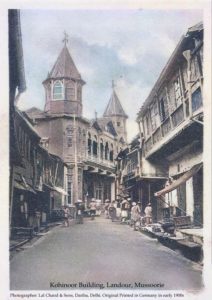
I was born into a family of modest means; the closest my family came to fortune was the padlocked wooden chests that delivered currency from the head office in Saharanpur to the Mansa Ram Bank across the street. We lived opposite the bank in Bhopal Shah’s building and had a view of the twin turrets of the Kohinoor Building. With childlike fascination, I watched the transfer of cash to the bank’s vaults. I remember the day the bank crashed. Milling around in the street below was a grey wave of agitated depositors. Wedged in a corner, shattered, bewildered and forlorn, like a broken bird sat Chotti Dei Behenji (that’s what the schoolchildren called her). She had lost everything.
‘Gone! Her life’s savings,’ my father said grimly.
How the mighty had fallen! There was a time when Sethji would go for a morning walk with half the bazaar in tow – silversmiths, tinsmiths, shopkeepers, traders, and merchants of all shapes and sizes. Banking was a dicey business in those early days. Landour’s Kohinoor building housed Messrs Bhagwan Dass & Company in 1890, with Mansumrat Dass, the owner’s son, as its manager. He became the first Indian to be nominated to the City Board.
Oftener than not, bazaar gossip, innuendo, and loose talk led to these financial upheavals. It is said that, tipped off by staff about a cash crunch, the Rajmata of Tehri withdrew her large deposit, which triggered a liquidity crisis that brought down the Mansa Ram Bank.
Banking definitely wasn’t a safe thing to get involved with in these hills.
Ganesh Saili, born and home-grown in the hills, belongs to those select few whose words are illustrated by their pictures. As the author of two dozen books, some translated into twenty languages, his work has found renown worldwide.