Discussion held on future of Offline Media at VoW Festival
By Arun Pratap Singh
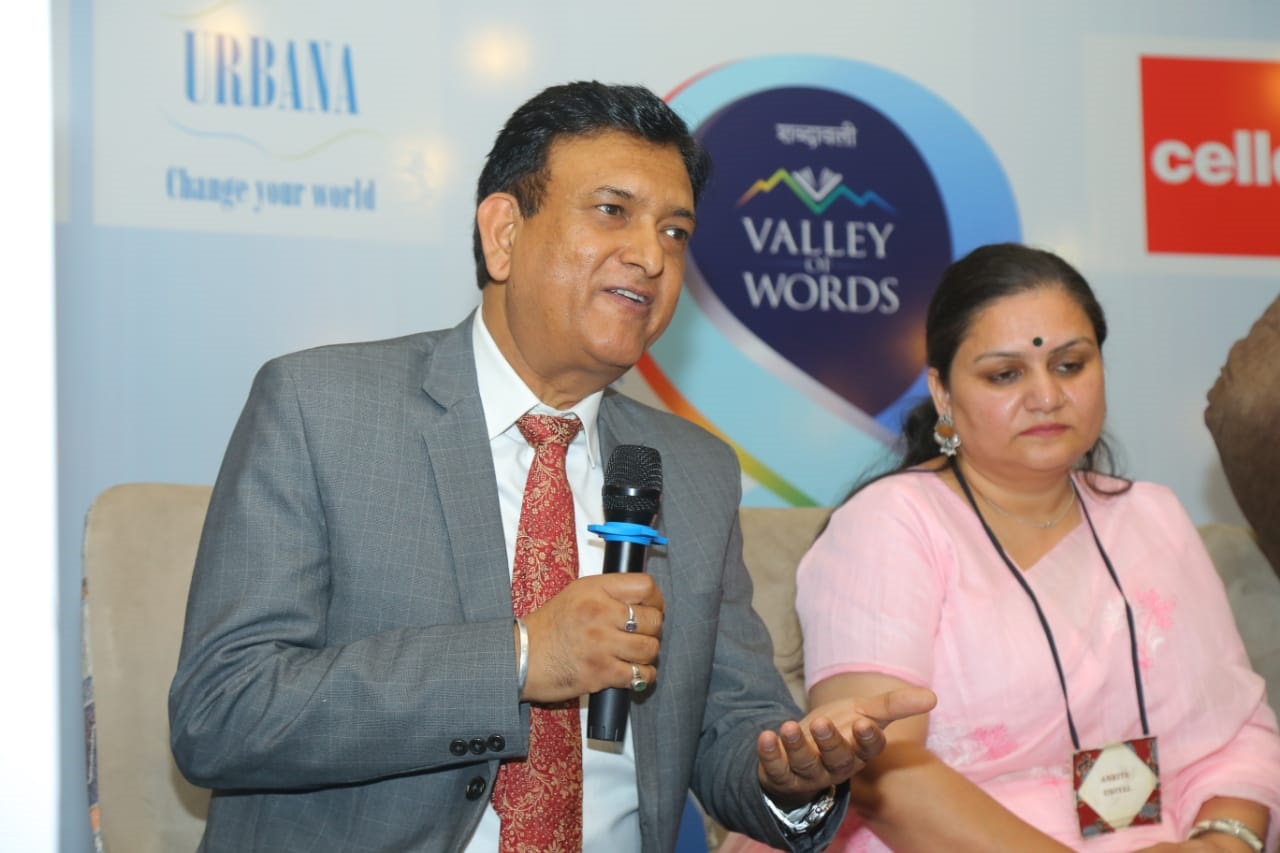
Dehradun, 16 Nov: On the first day of the two day Valley of Words Art & Literature Festival hosted here today, a very relevant and interesting session was held on the future of the offline and traditional media. The theme was “Present Tense and Imperfect Future of Offline Media”. The session was chaired by Director General of Graphic Era to be Deemed University, Sanjay Jasola while actor and radio broadcaster Navneet Gairola was the moderator of the session. Editor and Publisher of Garhwal Post, Satish Sharma, consulting editor of Amar Ujala, Sanjay Abhigyan and assistant professor in the Media and Mass Communication at Graphic Era Hill University, Dr Ankita Uniyal were the participants.
Dr Sanjay Jasola opened the session by asserting that digital evolution has impacted all domains including the media and that the future belonged to the digital media. He however expressed concern over the fact that reading habits of the younger generations were diminishing and over the fact that the span of the focus in case of the younger generation was also getting reduced. From a focus span of several minutes, the younger generation is left with a focus span of few seconds now. In view of this, he felt that the future of the offline media was at risk and that the Artificial Intelligence (AI) will become more and more pervasive in some years from now.
Sanjay Abhigyan, who has been editor of Digitial Media at Amar Ujala as well as Hindustan, however felt that the offline media’s existence even if challenged is not threatened. He cited a meeting held at the offices of Hindustan Times Group in Delhi where international experts on media had in the year 2006 predicted that the print media will not survive beyond 2025 and that the print media will be existing somewhere in the African continent. Abhigyan reminded that this did not turn out to be true. While admitting that digital media was growing at a faster pace as compared to the traditional print media, at present, the print media in India earned an advertisement revenue worth Rs 65,000 crore whereas the digital media attracted advertisement revenue of Rs 58,000 crore. The print media ad spread was still growing at 11 percent per annum. However, he added that in future, digital media will overtake the print media. He stressed that the future belonged to the convergence between the print and the digital media. Abhigyan further added that new technologies keep emerging and what is today a modern media platform may be called as traditional media in the near future.
Editor of Garhwal Post, Satish Sharma said that the charm of print media is impeccable and it still has a great future ahead. Reminding the audience that the future depends on what is being presented before the readers and rather than on the mode or type of media. He admitted that during the COVID period, the circulation of Garhwal Post had fallen to just 20 percent of the original numbers but after the Corona period, the newspaper was able to gain back its circulation lost during the Corona and now continues to be on the upswing. Sharma also said that digital media has changed the content which will be in demand in the print media and cited an example in support of his argument. He said that readers now know the latest score or results of a sports match and do not have to wait for the next morning to read to find out the score. However, they will still be interested in a deeper analysis of the game and therefore this is what should be presented to them. He also added that trust that print media carries with the readers is unparalleled as compared to the digital media. Sharma added that content and the quality of content are crucial. Even now, when many of the prominent readers do not get the Garhwal Post of the day, they often call him up to enquire why the newspaper had not arrived at their doorstep.
Dr Ankita Uniyal felt that the situation is rapidly changing and that the digital media and online media are rapidly growing compared to the traditional media. She however conceded that to verify the media content, however she still urges her students to refer to the print media as it carried greater credibility.
An interesting session was held on Cities of Future which was moderated by social activist Anoop Nautiyal with senior IAS officer and Additional Secretary to Uttarakhand Government, Dr Ashish Srivastava and Dr Avinash Joshi, member of NTPC chair at Doon University. The experts discussed the challenges and opportunities of urbanisation, emphasising the need for sustainable development and innovative urban planning. Dr Ashish Srivastava shared that during his research study in Netherlands, he observed that majority of residents preferred to ride bicycle to work or to study. Regarding the issue of carbon footprint raised by Nauityal, Srivastava reminded that walking contributed only 1 percent of carbon footprint as compared to vehicles in the cities which contributed to around 70 percent of carbon footprint. He stressed on inclusive, livable and sustainable infrastructure development in the cities. He also did not agree that the narrow lanes of Dehradun or lack of parking spaces poses much of the problem but added that what was required was change in behavioural pattern of the residents and the administration. He also said that India had turned into diabetes capital of the world because people were now walking much less in the country.
Dr Avinash Joshi felt the need of nature friendly planning and architecture for the cities of the future.
There was an interesting session featuring Manoj Mitta’s Caste Pride: Battles for Equality in Hindu India, with a compelling discussion with Badri Narayan led by Raja Sekhar Vundru. The discussion mostly dealt with legal aspects of atrocities on Dalits. Mitta also noted that caste based violence did not necessarily involve incitement by Brahmins or Rajputs but also by OBCs of dominant castes and felt that economic factors were also responsible for this.
The session chaired by Col Anupam Suden, explored the preservation of India’s archaeological heritage, with Manoj Saxena presenting invaluable insights into antiquities and their cultural significance.