Garhwal Post Bureau
Roorkee, 9 Aug: In response to the rapidly changing landscape of academic research, where Artificial Intelligence (AI) is redefining methodologies and shaping new possibilities, Quantum University successfully completed a five-day Faculty Development Programme (FDP), titled “Navigating Research in the AI Age: A Faculty-Centric Perspective”.
The programme was specifically designed to equip faculty members with AI literacy, practical research tools, and ethical best practices, enabling them to enhance the quality, efficiency, and impact of their scholarly work.
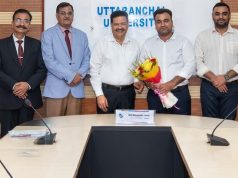
The programme began with a formal inaugural session introduced by Dr Sana Zaidi. The event was attended by eminent academic leaders Prof (Dr) Vivek Kumar, Vice Chancellor; Dr Amit Dixit, Registrar; Dr Satendra Kumar, Dean, Academics; Dr Manish Srivastava, Director, Quantum School of Business; Dr Brij Mohan, Director, Quantum School of Technology, among others.
In his keynote address, Dr Vivek Kumar highlighted that AI should not be perceived as a threat to human intelligence, but rather as a powerful catalyst for innovation, accuracy, and productivity in research. He emphasised that the faculty’s role is to adapt, evolve, and lead with responsibility in the AI-driven academic era.
Dr Manish Srivastava elaborated on the vision behind the FDP, stressing the importance of ethical AI adoption, transparency in research, and developing the next generation of responsible scholars.
The first day featured an eye-opening session by Dr Pushpendra Kumar Surya, Professor at Kirori Mal College, University of Delhi. He provided a comprehensive overview of AI’s role in the research process — from problem identification to literature review automation, data analysis, and ethical publication practices. His real-world examples showcased how AI can streamline tedious research tasks while maintaining academic integrity.
Day two was a fully interactive and practical session led by Dr Surya. Faculty participants explored AI-powered research tools, including Zotero – for reference management and bibliographic organisation; Scispace – for collaborative writing and AI-assisted formatting; Claude AI – for generating structured, context-aware research content; Jenni AI – for research drafting, summarisation, and idea expansion.
Through live demonstrations and guided exercises, participants learned to integrate these tools into their workflows. Discussions also covered responsible AI usage, highlighting the fine balance between efficiency and originality in scholarly writing.
The third day began with Dr Pallavi Bhardwaj, Assistant Professor in the Department of Commerce and Finance, explaining Bibliometric Analysis as a way to map citation networks, research trends, and scholarly impact. This session helped faculty members identify gaps in existing research and position their work for higher visibility.
Later, Dr Vinay Pal Singh conducted an in-depth workshop on research design and methodology. Faculty revisited essential concepts such as hypothesis formulation, variable classification, sampling techniques, and data collection methods, ensuring their research frameworks were robust and scientifically sound.
On the fourth day, Dr Ajay Kumar Chauhan, founder of Research Shiksha and an academician with over 23 years of experience, introduced faculty to advanced AI research platforms, including Orange – For data mining and visualisation; SciSpace – for enhanced literature review and writing assistance; and Paperpal – for grammar, clarity, and academic tone optimisation.
The session’s highlight was hands-on training in SmartPLS 4 (PLS-SEM), in which participants learned to apply statistical models to real datasets, interpret path coefficients, and evaluate model validity.
The final day provided deeper practice in SmartPLS hypothesis testing and structural modeling. Faculty members worked on creating their own research models, validating them, and discussing the implications of their findings.
A reflective session encouraged participants to share their key learnings and action plans for integrating AI tools into their future research projects. The feedback reflected renewed confidence and enthusiasm among faculty for embracing AI in a balanced and ethical manner.
The Valedictory Session, anchored by Rupali Khurana, Assistant Professor, Department of Commerce and Finance, summarised each day’s highlights as the official rapporteur. Gratitude was expressed to Ajay Goyal, President of Quantum University; all resource persons for their expertise and engaging delivery; and the participants. Certificates were awarded to all participants, marking the successful completion of the FDP.