By Lokesh Ohri
Dehradun is a valley that transcends any conventional description. Nestled between the Shiwaliks and the Middle-Himalaya, this narrow strip of land is cradled by the two most sacred rivers, Ganga and Yamuna. Its rivers have carried the songs of the mountainfolk down its streams. Its hills have preserved the silence of sages. Its temples, pathways, villages and institutions have witnessed the unfolding of histories that seldom find their way into conventional texts. Every stone has a memory, every trail a legend, and every community carries within itself an archive of lived experiences. In this idyllic enclave, where forests whisper secrets to the wind and the evening sky changes colour as if an artiste is furiously at work on a canvas, there is a cosy nook that lives stories, breathes poetry and finds immortality in words. This is the Valley of Words, a festival that celebrates the written word like no other.
The festival, however, is much more than a celebration of literature. It is a meeting of minds, a confluence of cultures, a gathering of memories, and an invitation to rediscover the extraordinary in the ordinary. Here, books do not merely remain objects resting upon shelves; they are journeys waiting to unfold. In the festival, a conversation can quickly become a pilgrimage, a poem can become a bridge, and a story can awaken an entire generation, for the valley itself has always been a storyteller.
My first association with the Valley of Words happened in 2017, the foundation year, where I was asked to take a group of about 60 Internet scribes, who called themselves the Indie-bloggers, for a heritage walk through the city. Because of the festival’s literary nature, we chose to walk the Ruskin Bond Childhood Trail. Along with colleague Sargam Mehra, we walked on the East Canal Road, Old Survey Road and Dilaram Bazaar, showing spots, and sharing stories associated with the legend. In the subsequent year, I was fortunate to share the stage with dear friend Jaskiran Chopra as a moderator, when she released her book on Ruskin Bond’s literary journey, a book that was also her PhD thesis.
The very next year, through our initiative Been There Doon That, that has encouraged people to look at Dehradun with renewed curiosity – to walk its streets, recognise its forgotten histories, and understand the cultural layers beneath its familiar landscape, we released the book, Walking with Laata, at the festival. I can clearly reminisce the buzz around the book in the festival with people walking up to me to argue why I used the word Laata, and if I did actually know what the full ramifications of the word in their native language were. Well, this is what a literary festival ought to do, evoke memories, stimulate debate and dialogue.
When Covid forced everyone indoors, the festival went online and I discussed Dehradun and Mussoorie’s heritage with friends Ajay Sharma and Samir Sinha. In various other sessions, I also discussed the contents and value of Indian texts archived across South Asia with Shyam Saran, Sudha Gopalakrishnan and Abhinav Kumar. I also was part of the deliberations on the extraordinary life of Rash Behari Bose, the revolutionary who lived in the valley, experimenting with bombs with chemicals sourced from the FRI’s laboratories.
In 2023, under the festival’s Authors from the Valley initiative, which has provided a platform for conversations with writers rooted in Dehradun and its surrounding cultural landscape, the festival hosted me for a discussion of my book Till Kingdom Come: Medieval Hinduism in the Modern Himalaya. It was an occasion that brought together scholarship, storytelling and the fascinating cultural geography of the Tons Valley, particularly the sacred world of Jaunsar-Bawar and its spiritual capital, Hanol. In this discussion in the festival, and like in many others that I have had the opportunity to listen to, one gets to travel beyond the printed page, entering a cultural universe inhabited by deities, legends, rituals, communities and beliefs that have evolved through centuries. Last year, too, brought together a wonderful panel that discussed the living traditions of Mahabharata in Uttarakhand.
And this year, I shall be discussing my new book, Ambles Across Godland, that takes us on a hundred ambles in the sacred landscape of Uttarakhand, interweaving the associated myth, mystery and history without blurring the boundaries of either – transporting the reader, as it were, to the space being described. These spaces have been described by me as I saw them while walking in them, curious and questioning, and yet humbly imbibing local ways of living that have sustained both landscape and people in this difficult yet picturesque terrain for ages.
In times when the world is obsessed with speed, who pauses to listen to the stories of the places we consider sacred? Valley of Words does. Discussions on the pluralities of language, arts, cultures, rituals, foods and histories allow us to understand that the past is not behind us; but it is beneath our feet, around our homes and within the traditions we sometimes overlook.
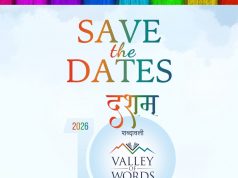
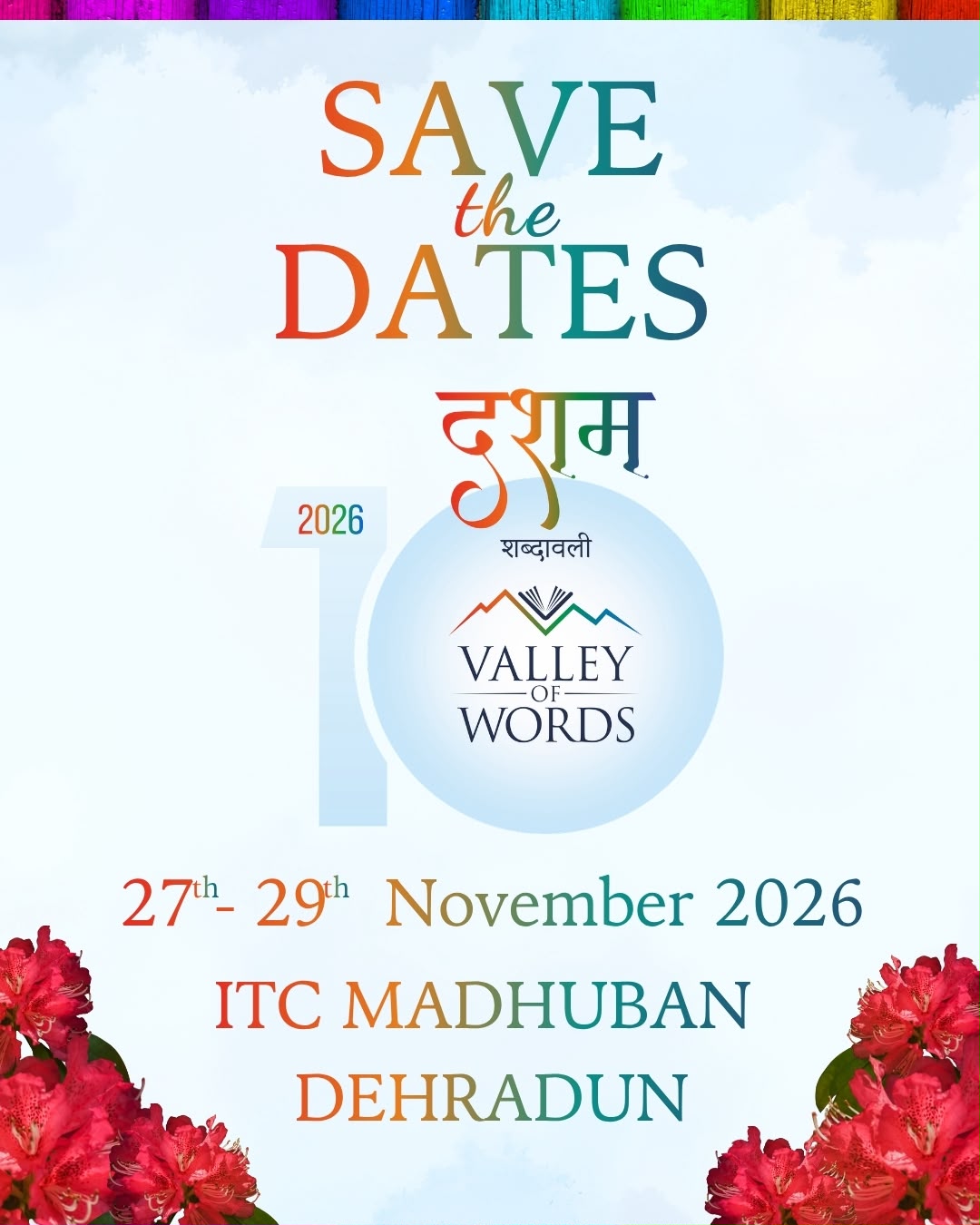
In its tenth year of yeoman service to literature, Valley of Words has embraced a larger vision by celebrating precisely this multiplicity. Its literature and arts festival, book awards, conversations, debates and creative engagements bring together diverse voices and perspectives. Its not-for-profit and volunteer-driven spirit lends the initiative a significance beyond the annual gathering. It nurtures an ecosystem in which ideas are exchanged, questions are encouraged, and the written word becomes an instrument of social and cultural engagement. This is where the real spirit of Valley of Words resides – not simply on the stage, not merely between the covers of books, but in the connections it creates.
(Lokesh Ohri is an author, anthropologist, wanderer).