 By Dr Anoop Virendra Kathait
The Uttarakhand film industry continues to struggle for a distinct identity, wider recognition and a sustainable audience base. Despite its immense cultural wealth, magnificent landscapes, linguistic diversity and historical richness, regional cinema has not yet succeeded in rendering these advantages into a strong cinematic exposure.
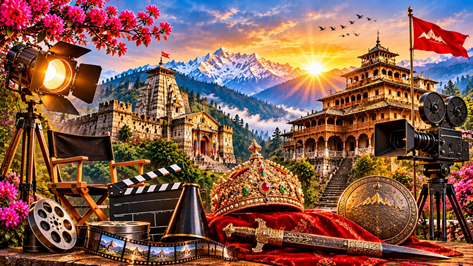
From the forgotten kingdoms of Garhwal and Kumaon to the valour of Jaunsar-Bawar, the Himalayas hold cinematic treasures waiting to be discovered. The mountains have witnessed the rise and fall of kingdoms, the courage of warriors, the sacrifices of ordinary people and the evolution of extraordinary civilisations. Their valleys preserve countless legends, their monuments whisper forgotten histories, and their folk traditions carry memories passed down through generations. Yet, remarkably, much of this extraordinary heritage remains unexplored by Uttarakhand’s film industry.
For years, a considerable part of regional filmmaking has revolved around familiar subjects—romance, migration, family relationships, social challenges and rural life. These are meaningful themes and deserve their place in cinema. However, an industry cannot continuously depend on a limited range of subjects and storytelling techniques. Cinema needs fresh imagination, bold experimentation and stories that can capture audiences beyond geographical boundaries. The question is not whether Uttarakhand has enough stories. The real question is whether its filmmakers are willing to explore the stories that have remained hidden in the pages of history. Uttarakhand is not merely a land of scenic locations; it is a land of extraordinary historical possibilities.
Like the Katyuri dynasty, the Chand rulers of Kumaon and the Panwar rulers, etc., of Garhwal provide fascinating foundations for historical dramas and period films. Their political struggles, changing alliances, military conflicts, royal traditions and contributions to regional culture could inspire compelling cinematic narratives. Imagine a historical series exploring the rise of the Katyuris, the political and cultural legacy of the Chand dynasty, or the evolution of the Garhwal kingdom.
Imagine bringing forgotten kings, queens, commanders, diplomats and warriors to life through powerful performances, authentic costumes, traditional architecture and meticulously recreated historical settings. These need not be merely grand productions. Even a carefully researched, modestly budgeted historical film can create a lasting impression if its storytelling is powerful.
Historical cinema can also help audiences understand how the region’s political boundaries, cultural identities and social traditions evolved over centuries. One of the most promising yet relatively unexplored territories for Uttarakhand cinema is Jaunsar-Bawar. Its distinctive cultural identity, warrior traditions, folk narratives, ancient customs and historical associations offer a fascinating world for cinematic exploration. The forgotten political warrior can also be the part of the story-telling.
Young viewers expect engaging narratives, strong visual presentation, technical excellence and contemporary cinematic experiences. Older generations often connect with cultural memories, historical authenticity and familiar traditions. Children need inspiring characters and stories that introduce them to the heritage of their own land.
A young person watching a film about a forgotten Himalayan warrior may discover a part of history never encountered in a textbook. An older viewer may reconnect with stories heard from grandparents. A child may develop curiosity about the region’s kingdoms, traditions and historical personalities. This is where cinema becomes more than entertainment. It becomes a medium of cultural preservation, education and collective identity.
Historical filmmaking demands serious research, credible scripts, professional direction, capable actors, production design, authentic costumes and attention to historical detail. The temptation to sacrifice authenticity for dramatic effect must be resisted. Filmmakers should collaborate with historians, researchers, writers, cultural practitioners and local communities. Their participation can help bring forgotten narratives to the screen without distorting their historical and cultural significance. Equally important are investment, modern filmmaking technology, professional marketing, cinema distribution and digital platforms.
Regional cinema cannot survive on enthusiasm alone. It needs an organised ecosystem in which creative talent, financial resources and professional opportunities grow together. There is also immense scope for young filmmakers, actors, musicians, writers and technicians from Uttarakhand. Historical and period productions could create new opportunities for local talent while bringing greater visibility to the region. A well-made film rooted in Garhwal, Kumaon or Jaunsar-Bawar can appeal to audiences across India and beyond.
The mountains have witnessed kingdoms rise and fall. Warriors have defended their lands, communities have preserved their traditions, and generations have passed down stories that deserve to be remembered. These are not merely fragments of the past. They are creative resources for the future. The industry must develop the courage to experiment, the discipline to research and the ambition to create films that command attention. This risk-taking attitude can transform the cinema-scope of regional expressions.
Uttarakhand does not need to invent a cinematic heritage. It needs to discover, interpret and bring its existing heritage to life. It is time to move beyond conventional filmmaking, beyond familiar frames and beyond regional limitations. Let the world see the Himalayas not merely as a beautiful destination, but as a civilisation with extraordinary stories to tell in an artistic way.
(The writer is an educator, poet, critic and short-story writer based in the Doon Hills.)