By Our Staff Reporter
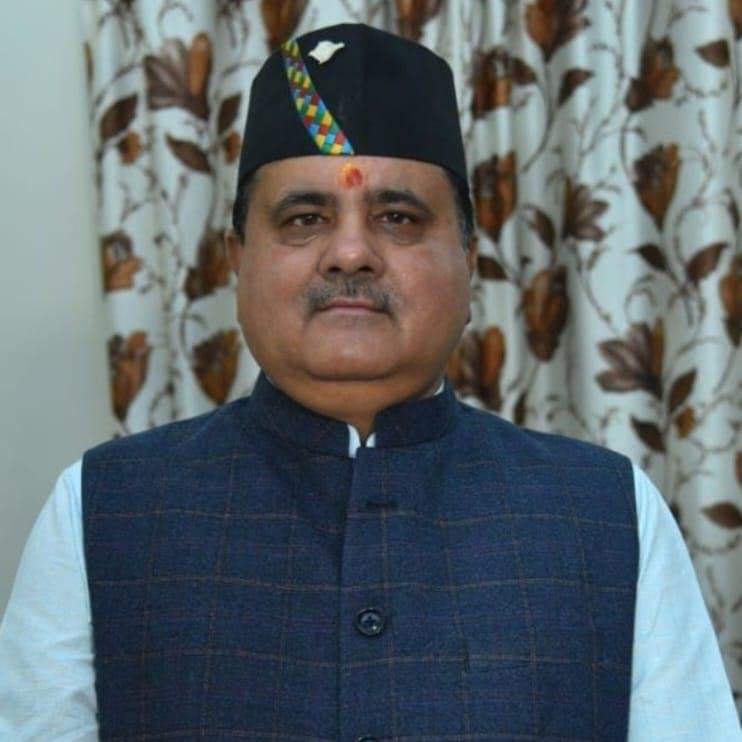
Dehradun, 14 Apr: State BJP President and Member of Rajya Sabha, Mahendra Bhatt has termed the proposed “One Nation, One Election” Bill as a landmark initiative vital for the making of a developed India. In a statement issued today, he emphasised the timeliness of the proposal and asserted that a constructive and inclusive debate must now unfold both within Parliament and in the public sphere.
He reminded that the concept is not novel to Indian democracy, and it was the norm until 1967. Bhatt asserted that those now opposing it, principally the Congress and its allies in the INDI Alliance, are doing so purely out of political expediency. He claimed that this is not merely a legislative reform but a revival of a time-honoured democratic tradition. He urged all political parties to rise above partisan interests for the nation’s greater good.
Expounding on the process, Bhatt remarked that a high-level committee chaired by former President and constitutional expert Ram Nath Kovind was constituted to examine the matter. The committee had consulted 62 political parties, of which 47 responded, with 32 supporting and the remaining 15 opposing the idea. Additionally, four former Chief Justices of India and nine former High Court Chief Justices deemed the proposal constitutionally sound. Consultations were also held with the Election Commission, Bar Council of India, ASSOCHAM, FICCI, CII, and various state election bodies. Bhatt noted that around 83 percent of public responses were in favour of the Bill.
It may be reminded there that the bill proposes conduct of simultaneous elections to the Lok Sabha and all State Assemblies. The bill has also proposed that in case of premature dissolution of any state assembly. re-elections would be held only for the remainder of the term. The implementation framework allows for phased adaptation until the year 2034, thereby enabling all electoral stakeholders, the Election Commission of India, the political parties, and voters, to adjust to the unified electoral calendar.
Bhatt claimed that frequent elections, held nearly every six months in some or the other state, severely hamper governance. Model codes of conduct stall developmental work and delay welfare schemes, while administrative machinery, including schoolteachers, are diverted to election duty. The 2024 Lok Sabha elections alone incurred a staggering expenditure exceeding Rs 1 lakh crores. In contrast, simultaneous elections could save approximately Rs 12,000 crore and potentially raise India’s GDP by 1.5 percentage points, amounting to a fiscal benefit of Rs 4.5 lakh crore.
The BJP MP also claimed that the One Election had the potential to boost voter turnout, He also cited examples in favour of his argument and reminded that in 1999, states holding simultaneous elections with the Lok Sabha recorded an 11.5 percent higher turnout. Kerala saw a 20 percent increase in 1977, and the northeastern states reported a 21 percent rise. The 2024 general elections saw a turnout of 65.79 percent, lower than the 67.40 percent in 2019, a trend simultaneous polls may help reverse.
Criticising the Congress, Bhatt recalled that it benefitted from simultaneous elections in the 1950s and ‘60s, yet disrupted this tradition by misusing Article 356 to frequently dismiss state governments. He condemned the present-day opposition as hypocritical, citing Congress’s past support through a 2015 Parliamentary Committee headed by its own leader, EM Sudarshan Nachiappan, and even letters of support from Sharad Pawar in 2019. He further claimed that late Karunanidhi had supported the concept, but his son MK Stalin now opposes it.
Bhatt further asserted that “One Nation, One Election” aligns with India’s democratic ethos and is not a tool for single-party dominance. Rather, it is a progressive stride towards efficient governance, fiscal prudence, and deeper democratic participation, he added.