Garhwal Post Bureau
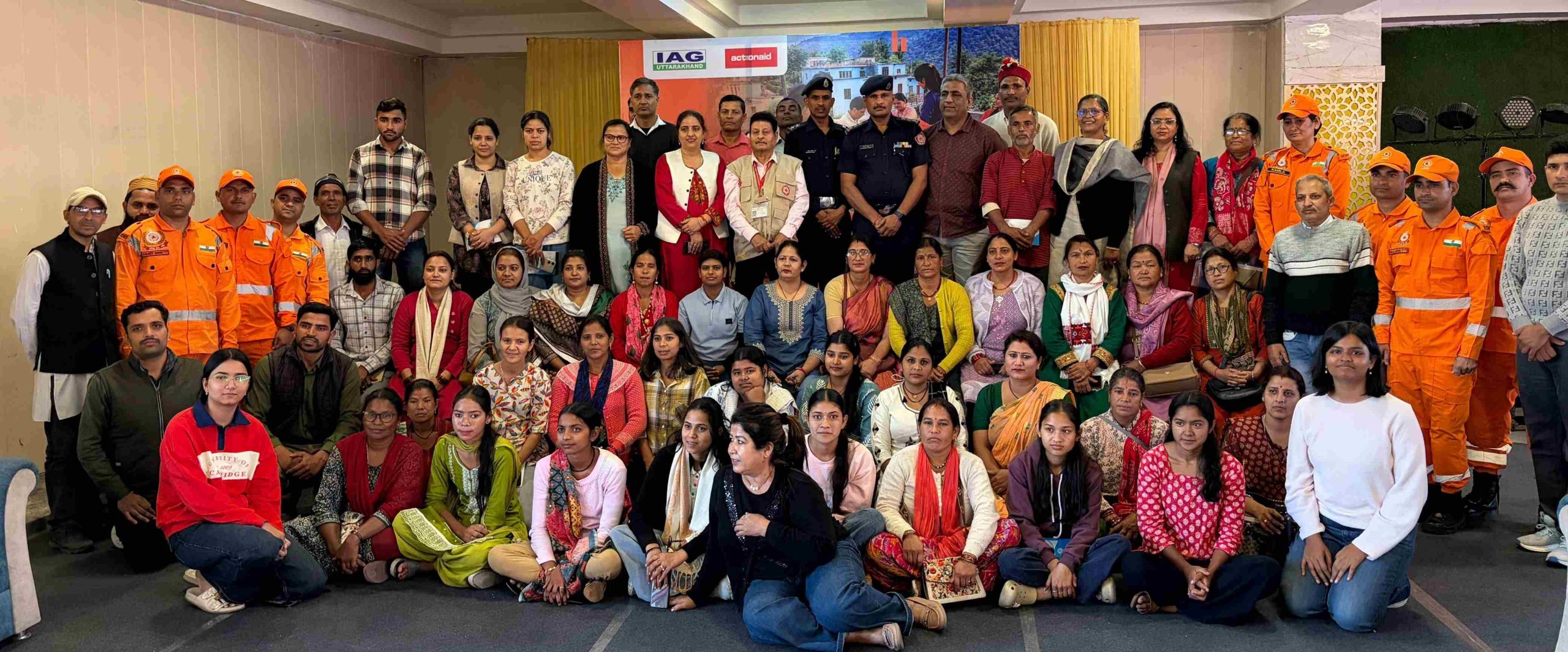
Dehradun, 17 Nov: On the second day of the Humanitarian Action School, jointly organised by ActionAid and the Inter Agency Group for disaster relief in Uttarakhand, people affected by disasters from different villages across the state shared their first hand experiences. Experts also provided insights into national and international standards, protocols and practices for humanitarian disaster response.
Khalid Chaudhary, Associate Director of ActionAid, said that national and international standards for disaster relief have been established to uphold humanitarian values and must be followed by everyone involved in relief operations. He emphasised that these standards are designed to reduce human suffering during disasters, save lives and ensure the dignity of affected communities.
He explained that the Government of India has enacted the Disaster Management Act, 2005, which provides the primary legal and institutional framework for effective disaster management in the country. The National Disaster Management Authority (NDMA), chaired by the Prime Minister, is the apex body responsible for disaster management in India. Under this institutional framework, prompt relief and response operations were undertaken during disasters such as Silkyara, Dharali and Tharali.
He further explained that the National Disaster Management Plan was introduced in 2016 and revised in 2019. It is aligned with the Sendai Framework and the Sustainable Development Goals (SDGs), focusing on understanding disaster risks, coordination and capacity building.
He also highlighted various mechanisms and frameworks, including the National Disaster Response Force (NDRF), the Incident Response System (IRS), and the Sphere Project, one of the most widely recognised sets of minimum standards for humanitarian response. The Sphere standards establish minimum requirements for the quantity and quality of essential services such as water, sanitation, nutrition, shelter and healthcare.
Dr Anil Verma, Chief Trainer of the Indian Red Cross Society, conducted a training session on fire-related emergencies and other hazardous situations. He pointed out that during a fire incident, most people wait for the fire brigade to arrive, which can be a critical and dangerous delay. Instead, people should make appropriate use of locally available resources and facilities wherever possible.
He also explained the importance of communicating accurate information when calling emergency helplines during disasters. First responders must be familiar with standard emergency communication codes to ensure that information reaches the concerned authorities quickly and accurately. He shared these communication codes with the participants, explaining how they help initiate immediate relief and rescue operations.
Fire Officer Dheeraj Singh Tadiyal explained various techniques for preventing fires and rescuing people during fire emergencies. He demonstrated the practical use of firefighting equipment and conducted a mock drill with participants from different parts of the state. Detailed information was provided on fire safety measures, emergency services and the appropriate use of equipment and technical resources in different emergency situations.
Commandant Santosh Kumar and Inspector Yogendra Kumar of the 15th Battalion of the NDRF conducted practical demonstrations and mock drills to strengthen community awareness and preparedness. They explained ways to respond to serious medical emergencies, threats posed by wild animals, other hazardous situations involving human safety and different types of disasters.
A notable aspect of the session was the active participation of trainees, who joined the NDRF personnel in performing practical exercises and enthusiastically attempted to learn the demonstrated rescue and response techniques.
Ranjita Dogra, Gram Pradhan of Bagori village in Harsil, Uttarkashi district, who witnessed the Dharali disaster firsthand, shared her deeply moving experience. She said that the horrifying scenes of that day would remain etched in her memory forever.
She recalled that the first warning signs came from across the Bhagirathi River, where residents of Mukhwa village began blowing whistles. However, within moments, Dharali village was transformed into a landscape buried under debris and mud.
She said that her immediate thought was to save as many people as possible. As soon as the flow of water and debris began to stabilise, villagers rushed towards Dharali to help those affected. People who had mobile numbers of Dharali residents began calling them to establish contact and find out about their safety. She added that the disaster had taken away much from the community, including the lives of loved ones, leaving behind painful memories and immense loss.
Sarojini Sipal, Gram Pradhan of Sipu village, and Vinita Marchhal, Gram Pradhan of Marchha village, who came from the remote border areas of Pithoragarh district, shared their experiences of living in villages along the India-Nepal border. They said that they had personally witnessed the disasters of 2013 and 2021. During those years, when disasters struck their region, people were left with almost nothing. The memories of those devastating events continue to haunt the affected communities.
Anmol Bisht also shared his story of resilience in the face of disasters. He pointed out that fire incidents are frequent in the Mori region of Uttarkashi district and are no less devastating than natural disasters. He said that disasters can strike Uttarkashi at any time without warning. The region also experiences frequent minor earthquakes, making preparedness essential.
Village Pradhans, ward members, women associated with self-help groups, village-level frontline workers and social activists from different parts of Uttarakhand emphasised that the state is highly vulnerable to recurring disasters. They said that training programmes for First Responders were essential to ensure preparedness and effective action during emergencies.
They also stressed the need to organise mock drills at the village level before disasters occur so that local volunteers and community workers remain prepared and can respond effectively whenever an emergency arises.
Participants further observed that during a disaster, locally available resources are often the first to be used. However, their effective utilisation is possible only when local people are properly trained. Therefore, Primary Responders have a crucial role to play in immediate disaster relief and response operations.
Participants in the workshop included Lalita Devi, Gram Pradhan of Naret village, Pithoragarh; Sarojini Sipal, Gram Pradhan of Sipu village; Vinita Marchhal, Gram Pradhan of Marchha village; * Ms Ranjita Dogra, Gram Pradhan of Bagori village, Harsil, Uttarkashi; Jai Bhagwan Singh Panwar, former Gram Pradhan of Dharali; Heera Jangpangi, an active social worker working on women’s issues; Kusum Ghildiyal, Coordinator of the Inter Agency Group; Bachchi Singh Bisht, Janmitra Organisation; Kalpana Thakur, Member of the Child Welfare Committee (CWC), Uttarkashi, and Secretary of the Tribal Women’s Welfare and Child Development Committee; Bhagat Singh Rana, Himalayan Manav Sansthan; Kushla Negi and Rajendra Chauhan; Karan Singh Panwar, Mahila Utthan Evam Gram Vikas Sansthan; Yatish Pant, Gurvinder Gill and Kamla Bisht from Nainital; Prajjwal Uniyal, Uttarkashi Disaster Management Janmanch.
Several other grassroots-level workers associated with different social organisations from various districts of Uttarakhand also participated in this important workshop.