Garhwal Post Bureau
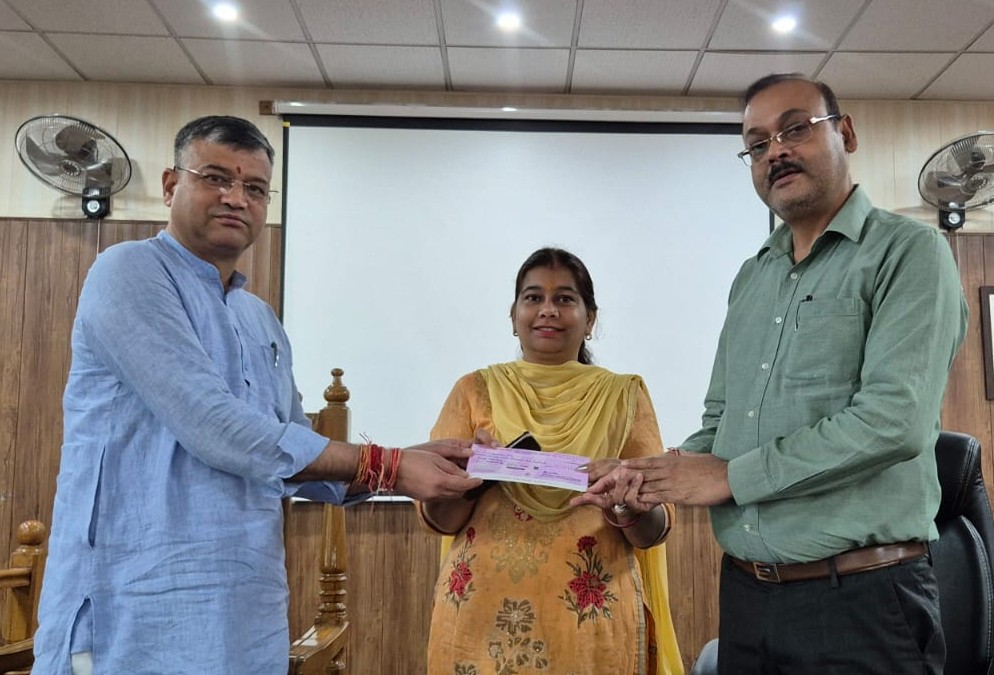
Dehradun, 3 Aug: Giving a further boost to the Government of India’s and Uttarakhand Government’s ambitious ‘Lakhpati Didi’ initiative aimed at making women economically self-reliant and empowered, the Dehradun Municipal Corporation (Doon Nagar Nigam) today handed over cheques towards user charges collected from door-to-door waste collection to 47 self-help groups (SHGs) engaged in sanitation work across different wards of the city.
The cheques were handed out during a programme held at the Municipal Corporation office by Mayor Saurabh Thapliyal and Municipal Commissioner Alok Kumar Pandey. Both Thapliyal and Pandey congratulated the women associated with the self-help groups and wished them success in achieving self-employment, self-reliance and economic prosperity on the occasion. Thapliyal said the Municipal Corporation is working continuously not only to strengthen the city’s sanitation system but also to promote women’s economic empowerment, with self-help groups forming an important link in this effort.
Addressing the gathering, Thapliyal said several welfare schemes are being implemented under the leadership of Prime Minister Narendra Modi for the economic and social empowerment of women. He said the objective of the ‘Lakhpati Didi’ initiative is to enhance the income of women associated with the SHGs and enable them to become financially independent. He added that the Municipal Corporation is translating this vision into reality by linking women with the city’s sanitation system and providing them with dignified employment and a regular source of income.
He said the active participation of women from self-help groups in the door-to-door waste collection system has not only strengthened the city’s sanitation mechanism but has also created a stable source of livelihood for hundreds of families. The Nagar Nigam intends to connect more self-help groups with sanitation, environmental protection and other municipal programmes so that more women could become economically empowered and contribute to the development of their families and society.
Municipal Commissioner Alok Kumar Pandey said that in accordance with the leadership and directions of Chief Minister Pushkar Singh Dhami, the state government is according the highest priority to women’s empowerment, self-employment and livelihood promotion. He said the Dehradun Municipal Corporation is carrying forward the same vision by associating self-help groups with sanitation work in different wards and ensuring them regular employment opportunities and income.
Pandey said the user charges collected through the door-to-door waste collection system are being distributed among the self-help groups (SHGs) in a transparent manner. This, he said, is leading to a steady increase in the income of women and helping them move towards achieving the goal of becoming ‘Lakhpati Didis’. He added that the initiative is not confined to strengthening sanitation services alone but is also an important step towards making women self-reliant, improving the economic condition of their families and providing them with dignified livelihoods.
He observed that SHGs have emerged as an effective instrument of social transformation, women’s empowerment, self-reliance and public participation, while also playing a significant role in the success of the Swachh Bharat Mission. The Corporation, he added, would continue to provide greater employment opportunities, training, capacity building and financial support to women self-help groups under the guidance of the CM so that more women can achieve the goal of becoming ‘Lakhpati Didis’.
Pandey further said the Municipal Corporation is developing a model in which urban sanitation and women’s economic empowerment progress together, making it an important step towards building a clean, beautiful and self-reliant Dehradun.
On this occasion, the Nigam’s performance in user charge collection during the financial year 2025-26 was also highlighted. It was informed that the Corporation had collected Rs 64,19,685 during the second quarter (July-September 2025), Rs 51,38,635 during the third quarter (October-December 2025) and Rs 81,62,198 during the fourth quarter (January-March 2026), taking the total collection for the financial year to Rs 1.972 crores. The officials attributed this achievement to the active participation of the SHGs, cooperation from citizens and an effective monitoring mechanism.
Based on the performance during the fourth quarter, the ‘Adarsh’ SHG of Ward 98 secured the top position by collecting user charges amounting to Rs 5,83,590. The ‘Apeksha’ self-help group of Ward 4 stood second with a collection of Rs 3,59,240, while the ‘Katyayani Aajeevika’ self-help group of Ward 64 secured the third position with a collection of Rs 3,30,430. Thapliyal and Pandey appreciated the outstanding performance of these groups, stating that these would serve as a source of inspiration for others and continue to play an important role in improving user charge collection and strengthening the city’s sanitation system.
On this occasion, the women beneficiaries expressed their gratitude to the Central and Uttarakhand governments, the Mayor and the Municipal Commissioner. They stated that the financial assistance received would help expand the activities of their SHGs, create new livelihood opportunities and strengthen the economic condition of their families. They expressed confidence that continued support from the Municipal Corporation would further encourage them towards becoming self-reliant.
The officials stated that the objective of involving self-help groups in sanitation activities extends beyond the waste collection and includes providing women with sustainable livelihoods, strengthening their financial position and effectively implementing women empowerment initiatives of the Central and Uttarakhand governments. The Corporation reaffirmed its commitment to continue integrating sanitation, public participation and women’s empowerment so that a larger number of women associated with self-help groups could become financially independent and achieve the goal of becoming ‘Lakhpati Didis’.