By OUR STAFF REPORTER
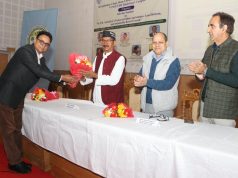
Dehradun, 17 Dec: The Indian Aerosol Science and Technology Association (IASTA)-2024 Conference commenced today at the Nityanand Auditorium, Doon University. It has been jointly organised by Aryabhatta Research Institute of Observational Sciences (ARIES) and Doon University. The inaugural session began with the traditional lighting of the lamp and Saraswati Vandana.
In her welcome address, Vice-Chancellor Prof Surekha Dangwal delivered a thought-provoking speech emphasising the far-reaching impacts of aerosols on human health, the environment, and climate systems. She underlined that aerosols, tiny particles suspended in the atmosphere, not only contribute to deteriorating air quality but also pose significant risks to respiratory and cardiovascular health, particularly in urban and industrial areas. Prof Dangwal stressed that understanding the complex behavior of aerosols requires a multidisciplinary approach, as their sources, movement, and effects intersect with diverse fields such as atmospheric science, environmental studies, public health, and technology.
Highlighting the significance of conferences like IASTA-2024, she noted that such platforms provide a valuable opportunity for researchers, academicians, and industry experts to collaborate across disciplines, share innovative ideas, and pave the way for evidence-based solutions. She emphasised that tackling the challenges posed by aerosols demands interdisciplinary research that integrates science, technology, policy, and community participation. Prof Dangwal also drew attention to the changing needs of industry and society in addressing environmental issues, particularly air pollution. She stressed the importance of developing industry-oriented curricula in universities to bridge the gap between academic knowledge and real-world applications.
Dr Neeraj Rastogi, Vice-President of IASTA, announced that the conference had received 200 registrations and 300 abstract submissions. He encouraged participants to visit the technology exhibition on campus. Guest of Honor Dr Manish Naja, Director of ARIES, noted that such conferences foster scientific collaboration and progress. Dr RP Singh, Director, IIRS, Dehradun, highlighted the complexities of aerosol measurement and the advancements in modeling techniques.
Chief Guest MLA Munna Singh Chauhan stressed the severe impact of aerosols on mountains, glaciers, and air quality in cities like Dehradun. He urged collective efforts to improve the air quality index (AQI) of the state and its capital.
The conference proceeded with a highly insightful keynote lecture by Prof Pratim Biswas from the University of Miami, a distinguished expert in aerosol science and air quality management. Prof Biswas delivered a comprehensive overview of strategies to combat air pollution, addressing both short-term solutions for immediate relief and long-term measures to tackle the pollution. For short-term mitigation, he emphasised practical steps that individuals and communities can adopt to protect themselves from hazardous air quality. These included wearing high-efficiency N95 masks in polluted areas, staying indoors during peak pollution hours, and using indoor air purification systems equipped with advanced filters. He stressed the importance of understanding meteorological factors like inversions, which trap pollutants close to the ground, exacerbating pollution levels, and called for public awareness to navigate such conditions effectively. Moving to long-term strategies, Prof Biswas highlighted the need to identify and address key pollution sources through rigorous scientific studies and technological innovations. He discussed the deployment of state-of-the-art sensor networks to monitor air quality in real-time, enabling better pollution control and targeted policy implementation. Prof Biswas also underscored the importance of adopting source-control technologies to reduce emissions at their origin, especially in highly polluted areas like the Delhi-NCR region.
A major focus of his lecture was the development of pyrolysis technology, a process that converts waste materials, including biomass and industrial by-products, into valuable resources like energy and clean fuel while significantly reducing emissions. Prof Biswas shared his pioneering work in this area and introduced his innovative startup, SmArT LLC (Sustainable Materials and Technologies). Dr Manish Joshi, Secretary, IASTA, presented the association’s key activities, emphasising the importance of bridging the gap between scientific knowledge and public awareness. The vote of thanks was proposed by UC Dumka, Convener, IASTA-2024, while Dr Vijay Shridhar served as the conference coordinator from Doon University.
Present were Registrar Dr Durgesh Dimri, Dean, Student Welfare, Prof HC Purohit, and faculty members, including Prof Kusum Arunachalam, Dr Archana, Dr Achlesh, Dr Ujjwal, Dr Charu, Dr Himani, Dr Sarita, Dr Naithani, Dr Chetna Pokhriyal, Dr Rashi Mishra, Dr Rajesh Bhatt, and Dr Rawal. Research scholars and students, including Anuj Chauhan, Isha Rayal, Sakshi Pundir, Kavita Mishra, Saurabh Rawat, Suniti, Shivani Dangwal, Bhuvan Bhandari, Himadri, Sakshi Pujari, Anshuman, Aditya Mohan, Priya Dimri, and Megha Rawat, actively participated in the event.