Garhwal Post Bureau
Srinagar Garhwal, 16 Apr: A two-day national seminar on the theme, “Relevance of Indian Knowledge Tradition in the Context of National Education Policy 2020”, was inaugurated today at the Birla Campus of Hemwati Nandan Bahuguna Garhwal University, Srinagar Garhwal.
The seminar has been funded by the Indian Council of Historical Research (ICHR). The inaugural session was dignified, well-organised, and academically significant. Its objective is to highlight the utility of the Indian knowledge tradition in the contemporary context and to create a platform for meaningful discussion on its integration with the National Education Policy 2020. The programme began with the lighting of a lamp in front of Goddess Saraswati and singing of the University’s anthem.
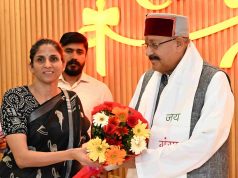
Guests on the stage were welcomed with robes and Tulsi plants, in keeping with Indian cultural traditions. The programme was conducted by Dr Anu Rahi.
In her welcome address, Professor Sunita Godiyal, Head of the Department of Education, described the Indian knowledge tradition as a vibrant tradition and highlighted its relevance to the current education system. Dr Amarjeet Singh, convener of the symposium, presented the outline of the topic and encouraged researchers to continue their research while maintaining faith in the Indian knowledge tradition. He stated that the National Education Policy 2020 is an important step towards the revival of the Indian knowledge tradition. He stated that the outline of this national symposium has been prepared keeping in mind the contemporary relevance of the Indian knowledge tradition. He stated that the primary objective of the symposium is to analyse various dimensions of the Indian knowledge tradition in the context of the National Education Policy 2020, enrich educational discourse, and provide a strong academic platform for researchers and academics.
He further stated that this event will encourage multifaceted dialogue, interdisciplinary approaches, and the exchange of innovative ideas, enabling concrete initiatives towards re-establishing the Indian knowledge tradition in a global context. Additionally, this symposium will serve to foster a passion for research among young researchers and inspire them to address contemporary educational challenges.
As the Chief Guest, Prof Murli Manohar Pathak, Vice Chancellor of Shri Lal Bahadur Shastri Rashtriya Sanskrit University, New Delhi, stated in his address that the National Education Policy 2020 is deeply rooted in Indian values, giving equal importance to intellectual, moral, and spiritual development. Describing intelligence, wisdom, and morality as the foundation of Indian education, he said that the purpose of education is to foster the all-round development of the individual and connect them with their culture. He also stated that this policy will play a crucial role in building a ‘developed India’ by the year 2047.
In his inaugural lecture, Prof Raj Sharan Shahi highlighted the philosophical depth and practical utility of the Indian knowledge tradition, stating that Indian thought embodies a remarkable synthesis of knowledge and science, which contributes to the holistic development of the individual.
Presiding over the programme, University Vice Chancellor Prof Shri Prakash Singh highlighted the university’s achievements and underscored the role of higher education institutions. He said, “Light the lamps, but be careful not to let darkness linger on Earth,” and described Indian knowledge as a force that spreads light in society.
At the end of the programme, Prof Anil Kumar Nautiyal formally proposed a vote of thanks. On this occasion, a special exhibition, titled “Uttarakhand’s Ramlila: A Visual Journey” was presented by Prof Dr Punita Gupta of Aditi College, Delhi University. This exhibition effectively showcased the diverse styles, costumes, forms, staging traditions, and the increasing participation of women in Ramlila, bringing Uttarakhand’s rich cultural heritage to life.
Prof MS Panwar, describing the symposium as essential and necessary for India’s future, said that the integration of the Indian knowledge tradition and the National Education Policy 2020 will play a crucial role in empowering and empowering the country.
Symposium co-convener Dr Puneet Walia stated that the objective of this symposium is to re-establish the Indian knowledge tradition in the context of the National Education Policy 2020 and to promote meaningful dialogue between researchers and academics.
Dr Shankar Singh stated in his address that this national symposium presents an academic and conceptual analysis of the relevance of the Indian knowledge tradition in the current context, and is a meaningful initiative towards integrating it with the principles of the National Education Policy 2020.
The inaugural session witnessed a significant attendance of scholars, researchers, professors, and students from across the country. The programme concluded with the collective singing of Vande Mataram.