 By Ganesh Saili
Nineteen square miles! That’s all one has to offer. Nothing more or nothing less. As for the rest, we depend upon the fun and frolic, chatter, and chatterboxes to fill our lives. Of course, I am guilty as charged, for being a bearer of the gossip picked over the years I have spent here on this hill trawling the narrow alleys.
I have been forewarned by the hill folk about the perils of gossiping: ‘The mouth of a hundred pitchers can be closed but not one man’s mouth.’
If you were to plant your feet anywhere along the ridge to the north, you would find the prospect of the serrated ridges of the mighty ranges of the Himalaya. On your east lie the hills of Tehri-Garhwal, while westwards spreads Park Estate, Cloud End and Benog Hill. Go southwards and you will almost debouch upon the plains of the Doon. This is where our early schools like Wynberg-Allen, St George’s College and Oak Grove in Jharipani were situated. Of course, as children in school, all we wanted to do was run away from the confines of its walls but strangely enough, we spend the rest of our years trying to get back in.
Awakening from surfing the net, my geeky friends see me as a dabbler in wordcraft. They say: ‘You’re in love with Mussoorie! All you need is a pencil and paper!’
Though when the muses abandon me, I walk on to the patio to top up the bird bath or fill up the empty bird feeders.
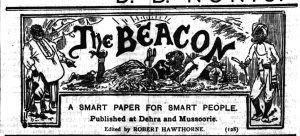
Today is different. There’s mail from Mark Windsor – an old Mussoorie buff – who has generously sent a slim copy of twenty-four pages of Mussoorie Rhymes. Robert Hawthorne was the owner-editor of The Beacon newspaper, published over five years from 1885 to 1890.
The preface reads like the statutory warning you find on any packet of tobacco: ‘Most books are written for an object, with an aim or to supply a want. This book is without an object, and certainly not wanted. The scraps of which it is composed first owed their origin to my desire to see myself in print, and they have already appeared in The Beacon. An irresistible craving induces me to share them and inflict them in one fell swoop upon the public.
‘I hereby render my scalp to the tomahawks of such reviewers as may dip into this little book set before them – to get their teeth on edge – and consequently feel bloodthirsty.’
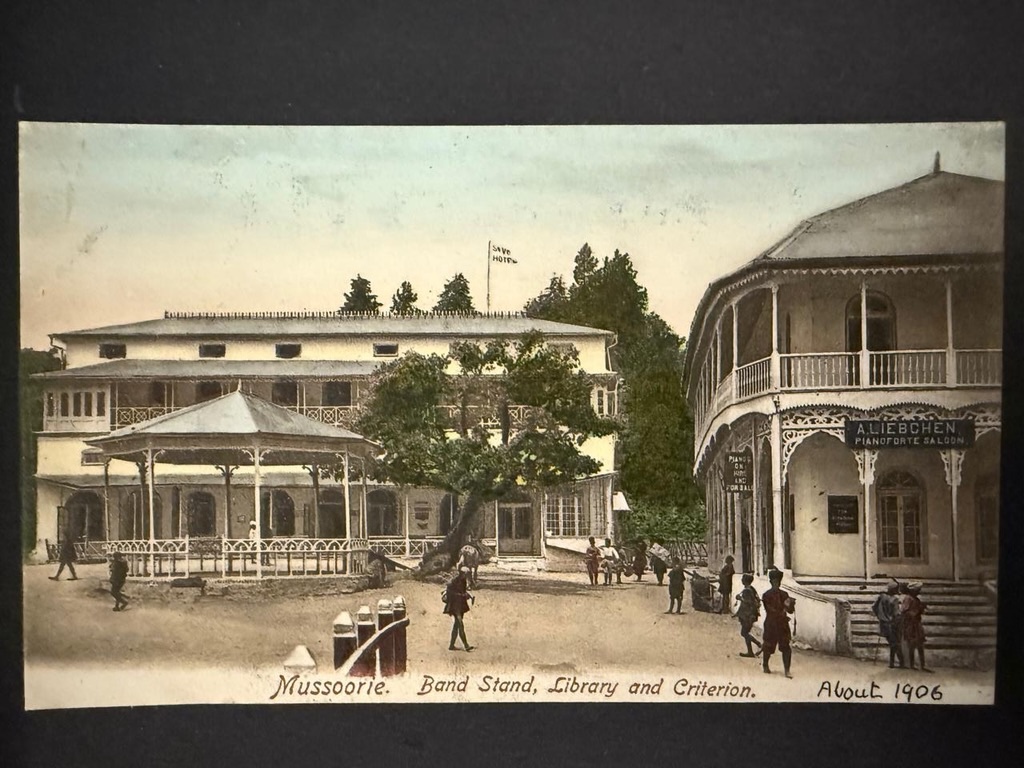
Of course, this is no great literature, but it offers the readers the old familiar names of Happy Valley, Camel’s Back, Kulri, and Library. They come together, weaving a magic. Dear Reader! I leave it to you to enjoy these harmless rhymes.
Be warned, though! Some of these may be as pointless as those early nursery rhymes we learnt in kindergarten, like Jack and Jill or Humpty Dumpty.
Those of you who enjoy these would do well to remember these were written a little over a hundred and twenty-five years ago, when this hill station was in its infancy. Therein lies the charm of the author’s efforts. It brings alive a phase in our history:
VI
There are hues a fare one wore,
Whom I saw standing at the door
Of the Mussoorie Library
V
Is he an angel, Oh! then if he be
He’s one “unawares” to Mussoorie and me.
For he’s always dressed nicely and looks too well-fed,
To be either an angel, or a ghost from the dead.
XI
I followed them around the Camel’s Back
A spoony-looking couple
The girl was short and very fair
The man was tall and supple.
It was witching time of eve,
When fond ones love to dally
And vow they “never will forget”
And never shilly shally.
XII
The hero of my song today shall be
One whom on the Mall you very often see,
Always equipped in a coat of the glossiest black,
Fitting without a wrinkle to his shapely back.
Little has changed around me. I do know that the more things change, the more they remain the same.
Ganesh Saili, born and home-grown in the hills, belongs to those select few whose words are illustrated by their pictures. Author of two dozen books, some translated into twenty languages, his work has found recognition worldwide.