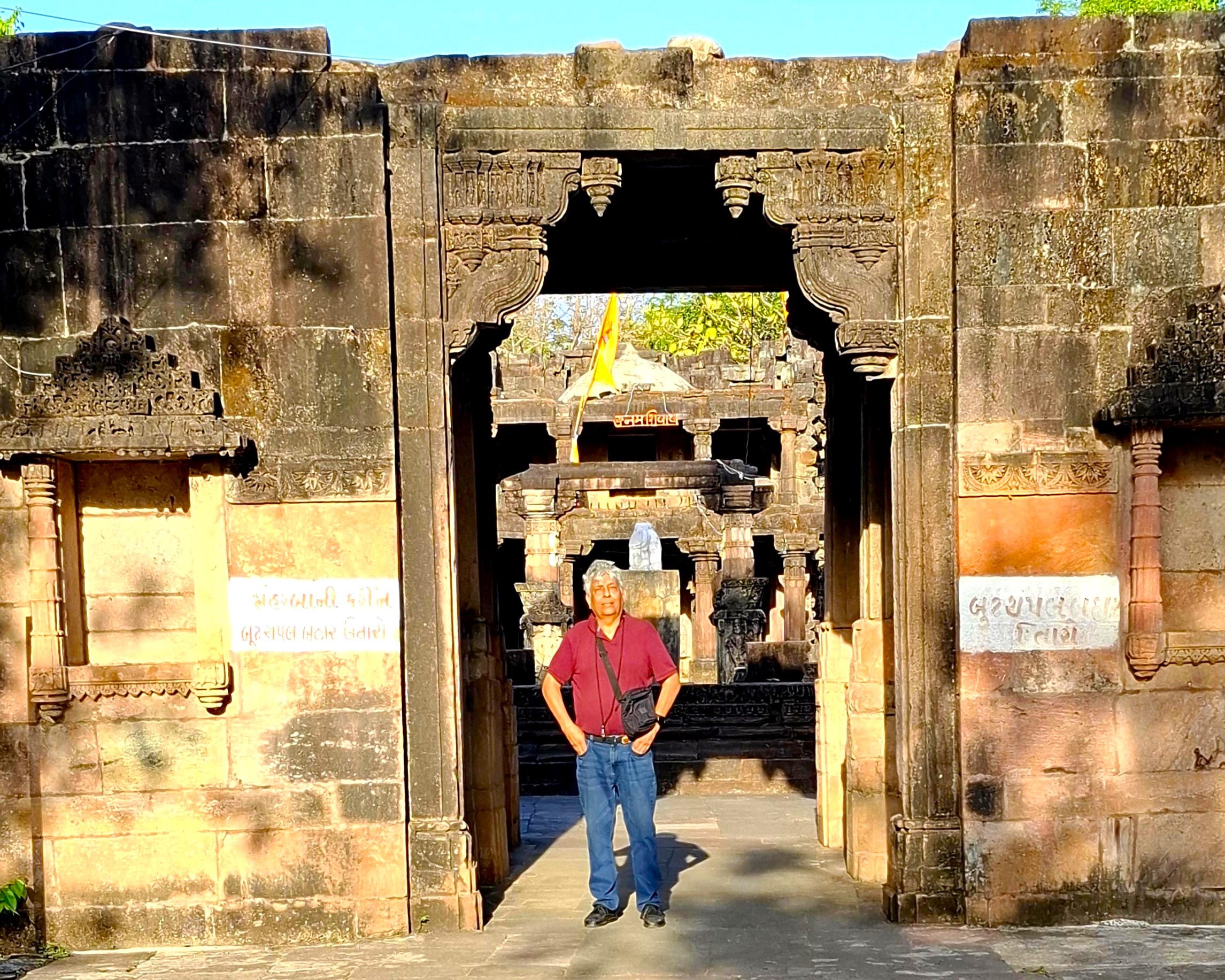
 By Kulbhushan Kain
The road climbed through winding hills, where the forest seemed to wrap itself around us silently. Time itself seemed to slow down.
We were in a trance. We almost missed it.
The forest track had narrowed to little more than a suggestion, and the teak trees on either side had closed ranks overhead. Then, without warning, a stone pillar emerged from the undergrowth -carved, deliberate, ancient – and I realised I was not alone in this jungle.
I was walking through someone’s city.
This is the Polo Forest Reserve, 400 square kilometres of dry deciduous forest in northern Gujarat, where the Aravalli Range begins its long, stubborn march toward Rajasthan. To the casual trekker, it is a sanctuary of teak and bamboo. To anyone willing to slow down and look, it is a Ghost City — a place where an entire civilisation simply vanished, leaving behind temples so exquisitely carved they make you stop mid-step and ask,
“Who were these people? And why did they leave?”
Let me make one thing clear. Polo Forest has nothing to do with the game Polo! The name Polo comes from the Marwari word pol – gateway. And indeed, this dense valley was once a strategic passage between the kingdoms of Gujarat and Rajasthan. And nestled shyly in it, is the small place called Abhapur (close to Idar which was a 15 gun salute princely state). Stand here long enough and you begin to notice something unsettling.
The sun barely reaches the valley floor. Two great peaks, Kalaliyo to the east and Mamrehchi to the west, stand like sentinels, blocking the light for most of the day.
Did the Parihar kings of Idar choose this shadowed valley deliberately – hiding their civilisation in perpetual twilight so that invaders would overlook it? Or did the darkness itself eventually defeat them?
Local legend says it did. The old people of this forest speak of a city that slowly lost its spirit, drained by years of half-light, until one day its residents simply walked away — leaving their temples to the leopards and the vines. Nobody recorded the day they left. Nobody wrote a farewell.
That silence is the first mystery of Polo.
As I pushed deeper into the forest, the ruins multiplied. Temples rose out of the foliage like stone mirages, their sandstone carvings still sharp after six centuries, their sanctums empty, their gods long gone or stolen. These are masterpieces of Maru-Gurjara architecture, and they rival the famous Dilwara temples of Mount Abu. Which raises an uncomfortable question, “Why would craftsmen of this extraordinary calibre choose to work in a remote, sunless ravine, invisible to the world?”
The answer, perhaps, lies in the Lakhena na Dera — a massive Jain temple over 150 feet in length, double-storeyed, ornate beyond reason for its jungle setting. Beneath its main sanctum is a secret chamber. Historians believe it was a vault, a hiding place for sacred idols and gold during times of invasion. So Polo was not built here by accident. It was built here precisely because it was hidden. This was a city designed to survive catastrophe, a place where priceless things were buried and kept safe while the outside world burned.
Someone, once, thought very hard about how to protect what they loved most.
I found myself wondering who that person was.
Further into the thicket stands the Sharneshwar Shiva Temple, and it stopped me cold.
In every Shiva temple I have ever visited, from the grandest to the most modest – the Nandi bull, Shiva’s devoted vehicle, sits lower than or at the same level as the Deity. It is the natural order of things: the devotee at the feet of the God. But at Sharneshwar, Nandi sits higher. Perched atop a tall pillar, the bull looks down over the Shiva Lingam below.
Why? Who sanctioned this inversion of sacred convention, and why did no one object? Some scholars suggest it points to a lost tantric tradition practiced in this forest. Others believe it commemorates a royal vow — that some long-forgotten king promised his God that his devotion would rise above all else. The temple does not answer. It simply stands there in the dappled forest light, quietly defiant, guarding its reason like a secret.
But of all the mysteries in Polo, the one that lingered longest with me was not a temple. It was a story.
Tucked into a far corner of the forest are the ruins known as “Sadevant Savlinga na Dera”, and they carry the weight of a love that ended badly. Sadevant was a prince. Savlinga was the daughter of a wealthy merchant. They met in this forest — secretly, repeatedly – in the way that lovers have always found each other in the spaces between duty and desire. What happened to them, exactly, no one knows any longer. The versions differ. But the ending is always the same: heartbreak, separation, ruin.
The local Adivasi communities who have lived alongside this forest for generations will not speak of these ruins carelessly. They believe the spirits of the ancient city’s residents still walk here after sunset, and that Sadevant and Savlinga are among them — still searching for each other in the shadows between the sandstone pillars.
When I stood at those ruins as dusk approached, I did not entirely disbelieve them.
What makes Polo different from every other archaeological site I have visited is that nature here is not a backdrop. It is a participant. The Harnav River runs through the forest, and along its banks grow over 450 species of medicinal plants. Nearly 300 species of birds live here, including the rare Grey Hornbill. In the monsoon, the ruins disappear almost entirely into an explosion of deep prehistoric green, and the line between the man-made and the wild becomes impossible to draw.
It is as if the forest is making a point –“These stones belong to me now.”
Each year, between December and February, the Gujarat Government organises the Polo Utsav -heritage walks, folk performances under the stars, rock climbing on the Aravalli faces. For a few weeks, the Ghost City stirs. Voices fill the valley again. Firelight flickers near the old temple walls.
And then the festival ends, the visitors leave, and Polo returns to its ancient silence.
As I walked back to my vehicle that evening, the forest closed behind me as if I had never been there at all. Somewhere in the shadows, a stone pillar stood exactly as it had for six hundred years – still carved, still deliberate, still waiting for someone to ask the right question.
I’m not sure any of us have asked it yet.
(Kulbhushan Kain is an award winning educationist with more than 4 decades of working in schools in India and abroad. He is a prolific writer who loves cricket, travelling and cooking. He can be reached at kulbhushan.kain@gmail.com)